



Introduction
If you’ve ever compared notes with a friend abroad about your baby’s birth weight, you may have noticed something striking: babies born in India are, on average, lighter than babies born in many other parts of the world. For decades, this was simply put down to poverty or “being a developing country.” But a landmark piece of Indian research showed that the real picture is more layered — and more useful for parents and expecting mothers to understand.
This article looks at that research, explains what it found in plain language, and discusses what it may mean for how we think about pregnancy nutrition and long-term health in India.
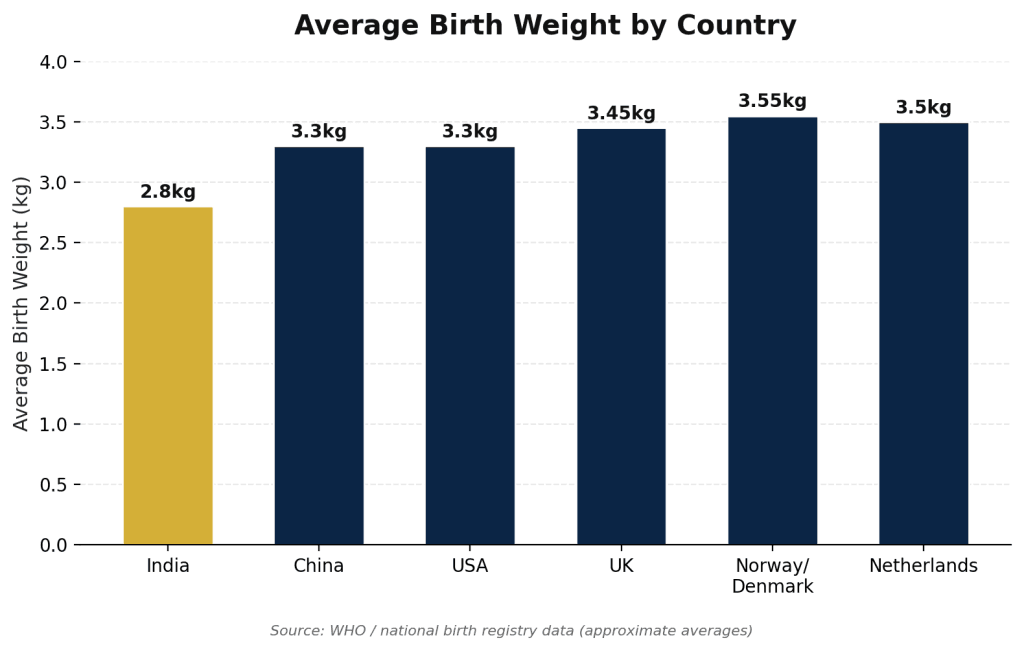
Figures are approximate national averages, compiled from WHO and national birth-registry data.
Key Findings from the Research
Table of Contents
ToggleResearchers who compared newborns in rural India with newborns in the United Kingdom found that Indian babies were not just smaller across the board — they were smaller in a very specific way. Compared to British babies, Indian newborns had noticeably smaller abdomens (a marker of how developed internal organs like the liver are) and less arm muscle. However, when researchers looked closely at the babies’ body fat, measured using skinfold thickness, that difference was much smaller.
In other words, Indian babies tended to be lighter and smaller in muscle and organ size, while relatively preserving their body fat compared to international standards. Researchers later described this pattern as the “thin-fat” body composition — a baby that looks slim on the scale but carries proportionally more fat than its muscle and organ development would suggest.
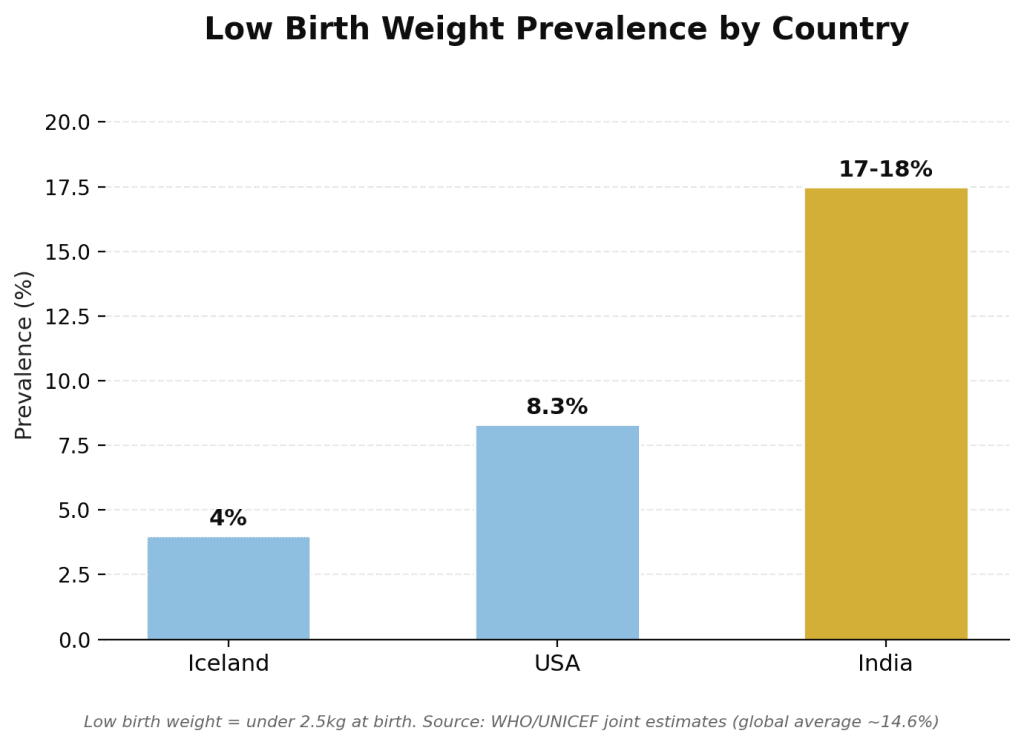
Low birth weight is defined as under 2.5 kg at birth. Figures are approximate, based on WHO/UNICEF joint estimates and national survey data; India estimates vary by data source (NFHS rounds report figures from roughly 16% to over 20%, partly due to home births not always being weighed).
How the Study Was Conducted
The research, known as the Pune Maternal Nutrition Study, was carried out by Dr. Chittaranjan Yajnik and colleagues, in collaboration with British researchers, and the results were published in the International Journal of Obesity in 2003.
The study team measured newborn babies and their mothers in villages near Pune, Maharashtra, and compared this data with babies born at a hospital in Southampton, UK, using similar measurement methods. Along with birth weight, they recorded several body measurements in the newborns: head circumference, arm circumference, abdominal circumference, and skinfold thickness at two sites on the body (a way of estimating fat under the skin). They also recorded the mothers’ age, height, weight, and body mass index (BMI) before and during pregnancy.
What Researchers Discovered
The contrast between the two groups of mothers was itself notable. On average, mothers in the Pune villages were younger, shorter, and lighter, with a lower BMI, compared to mothers in Southampton. This is consistent with what’s broadly known about maternal nutrition and body size across many parts of India compared to some higher-income countries.
When the researchers examined the newborns, the babies born in the Pune villages weighed less on average than the babies born in Southampton. But the more interesting finding was in how that lower weight was distributed across the body. The biggest reductions were seen in abdominal circumference and mid-upper-arm circumference — measurements linked to organ size and muscle mass. Skinfold thickness, a proxy for fat, was comparatively preserved.
Researchers interpreted this as a sign that when a mother’s own nutrition is limited during pregnancy, the developing baby’s body may prioritize keeping some fat stores while scaling back muscle and organ growth. This idea connects to a broader concept in medical research sometimes called the “thrifty phenotype” or “fetal programming” hypothesis — the idea that a baby’s body adapts, before birth, to the nutritional environment it expects to be born into.
What This Means for Patients
It’s important to be clear about what this research does and does not tell us.
- This is a well-known, peer-reviewed finding, not a fringe theory. The “thin-fat Indian baby” concept, first described from the Pune Maternal Nutrition Study, has since been discussed and studied further by researchers looking at metabolic health in South Asian populations.
- The findings are associative, not proof of a single cause. The study compared two specific groups of mothers and babies at one point in time; it does not mean every Indian baby will show this exact pattern, and body composition varies from baby to baby, family to family, and region to region.
- The relevance to later health is still an active area of research. Some researchers link this early body composition pattern to a higher lifetime risk of insulin resistance and type 2 diabetes, based on the broader science of how conditions in the womb can influence adult metabolic health. This connection is supported by follow-up research, but individual risk depends on many additional factors, including genetics, childhood nutrition, and lifestyle.
- Who this may be relevant to: expecting mothers who are underweight or have limited access to nutritious food during pregnancy, families with a history of low birth weight babies, and anyone interested in the long-term metabolic health of their child.
- This is not a reason for guilt. The research points to nutrition patterns that often start well before a woman becomes pregnant, and that are shaped by factors much bigger than any one family’s choices, including access to food, healthcare, and social patterns around who eats first in a household.
When to Speak With a Specialist
Research like this can raise a lot of questions that are worth discussing with a qualified doctor rather than trying to interpret alone. It may be worth speaking with an obstetrician, gynaecologist, or nutrition specialist if:
- You are planning a pregnancy and want guidance on nutrition beforehand, not just after conceiving.
- You are currently pregnant and have concerns about your weight, BMI, or diet.
- You have a personal or family history of low birth weight babies, anaemia, or gestational diabetes.
- You want to understand your baby’s growth measurements during antenatal checkups, rather than just the overall weight.
- You are considering how your baby’s early growth pattern might relate to future health monitoring, such as for blood sugar.
Every pregnancy is different, and decisions about nutrition, supplementation, and monitoring should be based on your individual health history. Being able to access the right specialist and compare guidance can make it easier to ask informed questions and make decisions you’re comfortable with.
Future Research and Next Steps
Since the original Pune Maternal Nutrition Study, researchers have continued to follow some of these children into later childhood and adulthood to see how their early body composition relates to markers like blood sugar, blood pressure, and body fat as they grow. Broader research also continues to look at maternal anaemia, teenage pregnancy, and access to antenatal nutrition support as factors influencing birth weight and long-term health across India.
Open questions that ongoing research is trying to answer include exactly how much of this pattern can be changed through better maternal nutrition, at what stage of a girl’s life nutritional interventions have the most impact, and how healthcare programs can more consistently reach mothers who need support the most.
Conclusion
The lower average birth weight seen in many Indian newborns isn’t simply a story about being “developing” versus “developed.” Research from the Pune Maternal Nutrition Study points to a more specific pattern — smaller organs and muscle mass alongside relatively preserved fat — that researchers believe reflects how a baby’s body adapts to its mother’s nutritional environment before birth. This is an important area of ongoing research with implications for maternal nutrition, but individual outcomes depend on many factors, and no single study can predict any one baby’s future health.
Medical Disclaimer: This article is for general educational purposes only and does not constitute medical advice, diagnosis, or treatment. Please consult a qualified healthcare professional for guidance specific to your health or pregnancy.
Frequently Asked Questions (FAQs)
It's a term researchers use to describe a body composition pattern seen in some Indian newborns: lower muscle mass and smaller organ measurements (like abdominal circumference) compared to babies born in some other countries, while body fat is relatively preserved. It doesn't mean the baby looks visibly fat — it refers to the proportion of fat relative to muscle and organ development.
Poverty and food access are important factors, but research suggests the picture is broader. Maternal age at pregnancy, anaemia, pre-pregnancy body weight, and how nutrition is distributed within a household can all play a role, independent of household income level.
No single measurement can predict this. Some research links early body composition patterns to a higher long-term risk of insulin resistance, but many factors — including genetics, childhood diet, and physical activity — influence whether this risk becomes a reality.
Research suggests maternal nutrition, especially before and during early pregnancy, plays an important role in fetal growth. However, meaningful change often needs to start earlier, including a girl's own nutrition and health well before she becomes pregnant.
Occasional variation is common and not automatically a cause for concern. However, if you have questions about your baby's growth measurements, it's worth discussing them with your pediatrician or obstetrician, who can assess this in the context of your baby's overall health.
Original Research Source
This article is based on findings from a scientific research study and related media reporting.
Media Coverage: https://link.springer.com/article/10.1007/s00125-025-06625-x
The content has been independently rewritten, analyzed, and simplified for educational purposes to help patients and families better understand the research findings.



1 Comment
Why 60 Feels Old in India But Not in Japan? The Actual Data.
[…] Why Indian Babies Are Born Lighter: What Science Says […]