


You’ve probably seen the clips: a 70-year-old running a marathon abroad, an 80-year-old lifting weights at the gym, a grandmother cycling or hiking on the weekend.
Then you look around your own neighbourhood.
- At 60, many people start complaining about knee pain
- At 65, climbing stairs becomes difficult
- At 70, many can’t get up off the floor without support
The common explanation: “Their genes are different. Their food is different. We eat ghee, milk, and millet — the best diet in the world. This is just how ageing works here.”
Is that actually true? Or is something else going on?
This article breaks down what national and international ageing data — not opinions — actually say about why physical decline hits earlier in India, and what can genuinely be done about it.
What Is "Life Expectancy" and What Does India's Number Actually Look Like?
Table of Contents
ToggleLife expectancy is the average number of years a person is expected to live. India’s number is meaningfully lower than several other countries, but that’s not even the most important gap.
- Japan’s life expectancy is around 84 years
- South Korea and Singapore are close behind, around 83 years
- India’s life expectancy is around 70–73 years — roughly 13–14 years behind Japan
That’s a real gap. But living longer isn’t the same as living well. That’s where the next number matters more.
The Number That Actually Matters: Healthy Life Expectancy (HALE)
Healthy Life Expectancy (HALE) measures how many of those years are spent in good health — able to walk, sit, stand, and function independently, without needing help.
- In Japan, healthy life expectancy is around 73 years
- In South Korea, it’s around 72.5 years
- In India, healthy life expectancy is estimated at only around 58–60 years
Put these two numbers side by side, and a clearer picture appears:
- Unhealthy years (years spent frail, sick, or dependent on others):
- Japan: roughly 10 years, at the tail end of an 84-year life
- India: roughly 10–13 years, but at the tail end of a much shorter life — meaning dependency often starts by 60
This is the real difference. A person in Japan isn’t just living longer — they’re living independently for more of those years. In India, the “dependent, unwell” phase tends to arrive much earlier in life, not just at the very end.
What Does India's Own Research Say About Ageing?
India’s largest study on ageing — LASI (Longitudinal Ageing Study in India) — found that roughly 3 in 10 older Indians are physically “frail,” and the gap between men and women is unusually wide.
Key findings from LASI and related national data:
- Overall frailty prevalence among Indians aged 60+ is close to 29–30%
- Frailty is higher in women (roughly 32–37%) than in men (roughly 27%)
- In a WHO-led comparison across six developing countries — China, Ghana, Mexico, Russia, South Africa, and India — India recorded the highest frailty prevalence of the group, and the gender gap was also the widest
What Does "Frailty" Actually Mean?
- It is a recognised medical term, not just “feeling weak”
- It’s measured using five factors: unexplained tiredness, weak grip, slow walking speed, low physical activity, and unintentional weight loss
- Someone is classified as “frail” when several of these are present together — it directly predicts falls, hospitalisation, and loss of independence
Grip Strength: A Simple Number With a Big Warning
Hand grip strength is used worldwide as a reliable stand-in for overall body strength — and India’s national average is on the lower side.
- LASI data shows the average grip strength for men aged 60+ in India is around 36 kg, and for women, around 24 kg
- Weak grip strength is linked to a higher risk of falls, bone and joint disease, and difficulty with daily activities
- Globally, grip strength is treated as an early-warning indicator — it often predicts future health problems before other symptoms appear
Bone Health: A Hidden Crisis, Especially After 50
Bone loss in Indian women accelerates sharply after age 50, and a large share of the population — men included — already has weakened bones (osteopenia) well before old age.
- A large Indian study of over 31,000 adults found nearly 1 in 2 had osteopenia (weakened bones), and roughly 1 in 5 had osteoporosis
- The same research found osteoporosis prevalence jumps sharply in people aged 60+ compared to those under 60
- A separate study of postmenopausal women in Punjab found roughly 3 in 10 already had osteoporosis, with weakened bones (osteopenia) present in over 4 in 10
Why Does Bone Loss Speed Up After Menopause?
- Oestrogen helps protect bone density — levels drop sharply after menopause
- Without enough vitamin D, calcium, and protein, bone loss accelerates further
- This is why fractures and hip injuries after a fall become far more common in women past 50
Falls: Often the Real Turning Point
A fall in an elderly person is rarely “just an accident” — it’s frequently the event after which mobility and independence decline permanently.
- LASI data shows that frail older adults have a noticeably higher rate of falls, repeated falls, and fall-related injuries than non-frail older adults
- Weak grip strength, balance problems, and bone and joint disease are all linked to higher fall risk
- After a serious fall, many older adults never fully return to their previous level of activity
So Why Does This Happen? Four Real Reasons (Not "Bad Genes")
The gap isn’t genetic — it comes down to when strength is built, how it’s maintained, whether diet matches modern lifestyles, and whether elders are encouraged to stay active.
Reason 1: Peak Strength Is Built Once — And India Often Misses the Window
- The human body builds most of its peak muscle mass and bone density between roughly ages 25–30
- After that, the body slowly spends this “reserve” for the rest of life
- In India, this exact age window (20s–30s) is usually consumed by exams, career pressure, and marriage — with little to no structured physical training
- The result: many people enter their 60s and 70s with a much smaller physical “reserve” to draw from
Reason 2: A Walking-Only Culture, With Little Strength Training
- Ghee, dairy, and millets are genuinely nutritious — they aren’t the problem
- The issue is that this diet was originally built for a physically active, labour-intensive lifestyle — farming, walking long distances, manual work
- Today’s lifestyle is largely sedentary (desk jobs, vehicles), but the calorie-dense diet has stayed the same
- Without matching physical activity, that same “fuel” is more likely to convert into fat rather than strength — a pattern linked to India’s rising rates of obesity and diabetes
Reason 3: A Traditional Diet Built for a Different Lifestyle
- Ghee, dairy, and millets are genuinely nutritious — they aren’t the problem
- The issue is that this diet was originally built for a physically active, labour-intensive lifestyle — farming, walking long distances, manual work
- Today’s lifestyle is largely sedentary (desk jobs, vehicles), but the calorie-dense diet has stayed the same
- Without matching physical activity, that same “fuel” is more likely to convert into fat rather than strength — a pattern linked to India’s rising rates of obesity and diabetes
Reason 4: Widespread Vitamin D and Protein Deficiency
- Multiple Indian studies estimate that 70–90% of the population is vitamin D deficient — despite India getting abundant sunshine year-round
- Without enough vitamin D, the body cannot properly absorb calcium — so dairy intake alone doesn’t protect bone health
- India’s average protein intake is estimated at around 47g per day, compared to a global average of around 68g per day
- Protein is essential for maintaining muscle, especially as the body ages
Regional and genetic factors also shape how these patterns show up across India — for context on how location-specific health risks are studied here, see:
The Cultural Layer: When "Respect" Means "Sit Down and Rest"
This part isn’t medical — it’s cultural, but it matters just as much.
- In many Indian households, “respecting” an elder often means stopping them from doing physical tasks — carrying things, climbing stairs, going out alone
- It comes from love, not bad intent
- But the body follows a simple rule: movement that isn’t used is lost
- A joint that doesn’t move stiffens; a person who doesn’t walk regularly eventually struggles to walk at all
In many countries with higher healthy life expectancy, retirement is treated as a phase to start new physical activity — hiking clubs, cycling groups, structured strength programs for seniors are common and often publicly supported. In India, the cultural default often runs the opposite way: growing older is treated as a signal to slow down and rest.
Can This Actually Be Reversed?
Yes. Research consistently shows that muscle strength, bone density, and balance can improve at almost any age — even in people in their 80s and 90s.
What genuinely helps, based on the research above:
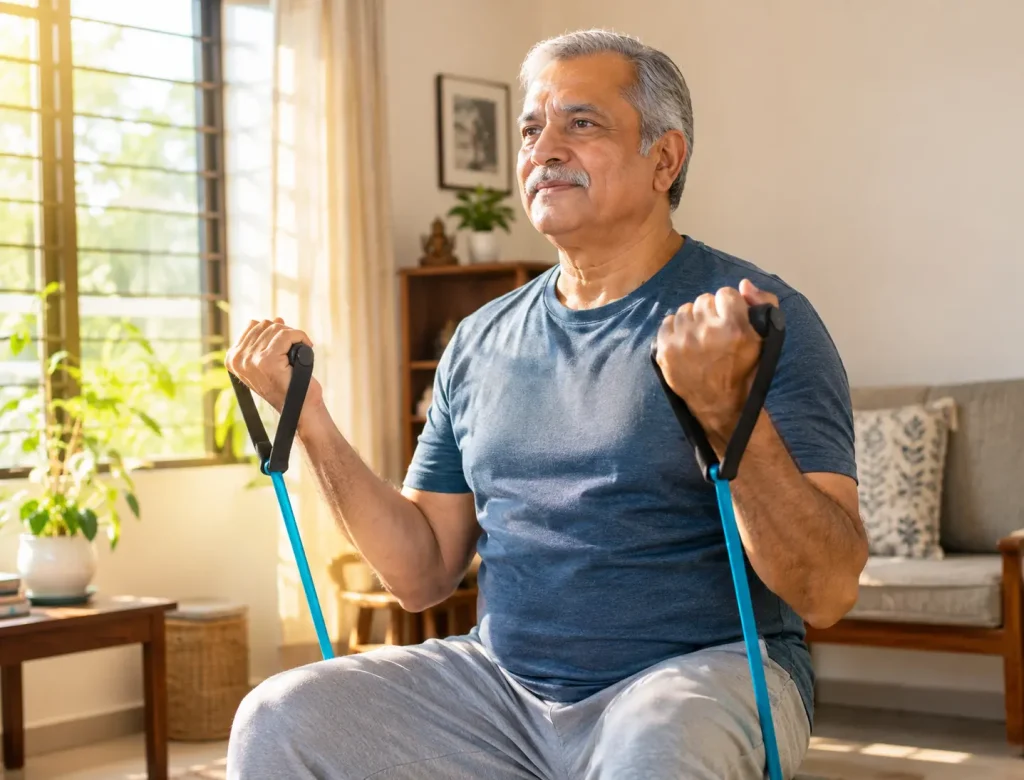
- Add strength training, not just walking — 2–3 sessions a week involving resistance (light weights, resistance bands, or bodyweight exercises), ideally guided by a doctor or trainer, especially if any existing condition is present
- Add protein to every meal — not just one meal a day; sources like dahi, milk, paneer, and eggs help offset age-related muscle loss
- Get vitamin D and bone density checked — particularly important for women after age 50, when bone loss accelerates sharply
How ConsultGrab Can Help
Understanding why physical decline happens is only the first step — getting the right specialist input is what actually helps.
ConsultGrab connects patients with trusted specialists for exactly these kinds of age-related concerns — including Knee Replacement Consultation for severe joint pain or arthritis, and Back & Spine Surgery Consultation for chronic pain, slipped disc, or nerve compression. If bone health, joint pain, or mobility issues are already affecting you or a family member, getting an expert evaluation early — rather than waiting — tends to make a real difference in outcomes.
Frequently Asked Questions (FAQs)
No. Research points to lifestyle and habit gaps — lower strength training, vitamin D and protein deficiency, and less structured physical activity — not genetics.
It's the number of years a person is expected to live in good health, able to function independently, as opposed to total years alive.
LASI data shows women have higher frailty prevalence than men in India, and the gender gap is wider here than in several comparable countries — likely linked to nutrition, bone health, and activity levels.
No. Walking supports heart health but doesn't build muscle or bone density on its own — that requires resistance or strength-based activity.
Indoor lifestyles, limited sun exposure, and low dietary vitamin D intake are the main contributing factors, even in a sunshine-rich country.
Earlier is better — ideally in the 20s and 30s when peak muscle and bone mass are built — but research shows meaningful strength gains are possible even for people in their 70s, 80s, and beyond.
Yes. Multiple studies confirm that with the right combination of strength training, protein intake, and vitamin D correction, older adults — even in their 80s and 90s — can rebuild strength and balance.
A note on this article: all statistics above are drawn from published national and international ageing research (LASI, WHO-SAGE, and peer-reviewed Indian studies), linked throughout. No figures have been estimated or invented.