

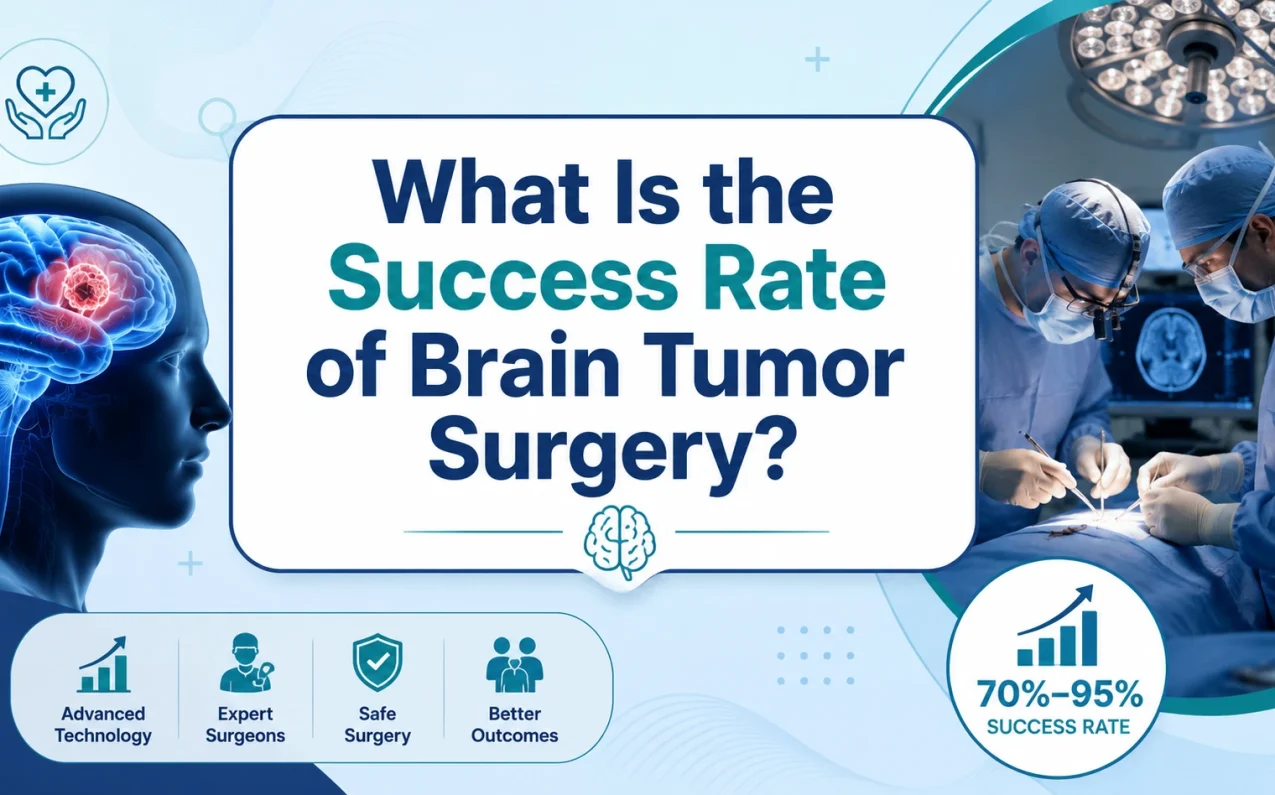
Hearing the words “brain tumor” can be overwhelming. One of the first questions many patients and their families ask is: “What is the success rate of brain tumor surgery?”
The answer is not a single percentage. Brain tumor surgery outcomes vary depending on the type of tumor, its location in the brain, and the patient’s overall health. Thanks to modern neurosurgical techniques, brain tumor surgery has become significantly safer and more effective than it was decades ago.
This guide explains what success means in brain tumor surgery, the factors that influence outcomes, and what patients can realistically expect.
Quick Answer
Table of Contents
ToggleThe success rate of brain tumor surgery generally ranges from 70% to 95%.
However, this percentage depends on:
- Whether the tumor is benign (non-cancerous) or malignant (cancerous)
- The location of the tumor inside the brain
- The possibility of removing the tumor safely
- The patient’s age and overall health
Success is measured not only by removing the tumor but also by preserving important brain functions and improving quality of life.
What Does "Success" Mean in Brain Tumor Surgery?
Many people assume that success means completely curing the disease. In reality, brain tumor surgery has different goals depending on the individual case.
For surgeons, a successful operation means:
- Removing the tumor as safely as possible
- Protecting healthy brain tissue
- Preserving important functions such as speech, movement, and vision
For patients, success means:
- Better quality of life
- Reduced symptoms
- Safe recovery
- Improved long-term health whenever possible
Because every brain tumor is different, the definition of success varies from patient to patient.
What Affects the Success Rate of Brain Tumor Surgery?
Several important factors influence surgical outcomes.
1. Type of Brain Tumor
The nature of the tumor has the greatest impact on surgery.
Benign Brain Tumors
Benign tumors are non-cancerous and usually grow slowly.
Examples include:
- Meningioma
- Acoustic Neuroma
For these tumors, surgery often produces excellent results.
Typical success rate: 90%–95%
If the entire tumor can be safely removed, many patients recover well, and the chance of recurrence is usually low.
Malignant Brain Tumors
Malignant tumors are cancerous and tend to grow more aggressively.
For these tumors, surgery is often performed to remove as much of the tumor as possible. This helps improve the effectiveness of treatments such as radiation therapy and chemotherapy.
Immediate surgical success rate: Approximately 60%–80%
Although surgery can significantly reduce tumor size, long-term outcomes may remain more challenging because malignant tumors can return or continue to grow.
2. Tumor Location
The location of the tumor inside the brain plays a major role in surgical planning.
Tumors located near the surface of the brain are generally easier and safer to remove.
However, surgery becomes more complex when the tumor is close to areas responsible for:
- Speech
- Vision
- Movement
- Other critical brain functions
In these situations, surgeons must balance maximum tumor removal with preserving the patient’s neurological function.
Modern techniques, including awake craniotomy, allow surgeons to monitor important brain functions during surgery. During this procedure, the patient remains awake for part of the operation so speech and movement can be tested while the tumor is being removed. This helps reduce the risk of damaging critical areas of the brain.
Is Brain Tumor Surgery Safe?
Brain surgery naturally sounds frightening, but advances in medical technology have greatly improved safety.
Today’s neurosurgeons use advanced tools such as:
- Neuro-navigation systems
- High-definition surgical microscopes
- Intraoperative MRI imaging
These technologies help surgeons locate tumors more accurately and reduce the risk of injury to healthy brain tissue.
As a result, brain tumor surgery is considerably safer than it was several decades ago
What Is the Risk of Death During Brain Tumor Surgery?
Many patients worry about the possibility of dying during or shortly after surgery.
According to broad medical data discussed in this topic:
The 30-day mortality rate after brain tumor surgery is approximately 1% to 4% in well-equipped hospitals.
This means the risk has become relatively low due to improvements in surgical techniques, imaging technology, and specialized neurosurgical care.
READ MORE: What Is the Success Rate of Brain Tumor Surgery? Learn how success rates vary based on tumor type, location, and modern surgical techniques.
Why Individual Evaluation Matters
Statistics can provide a general idea of expected outcomes, but they cannot predict the future for a specific patient.
Every brain tumor case is different because of factors such as:
- Age
- Overall health
- Tumor characteristics
- Surgical complexity
- Individual recovery potential
This is why treatment decisions should always be based on a thorough evaluation by an experienced neurosurgical team rather than general percentages found online.
How ConsultGrab Can Help
A brain tumor diagnosis often brings many questions about treatment options, surgery, recovery, and choosing the right specialist. Having reliable guidance can make the journey less stressful.
At ConsultGrab, we help patients connect with experienced medical specialists and trusted hospitals for expert evaluation and treatment planning. Our care team also provides appointment support, treatment guidance, and transparent information so patients and families can make informed healthcare decisions with confidence
Conclusion
The success rate of brain tumor surgery generally ranges from 70% to 95%, but there is no single number that applies to everyone. Outcomes depend largely on the tumor type, its location, and the patient’s overall condition.
Modern surgical techniques have made brain tumor surgery safer than ever before, with low mortality rates in experienced centers and excellent outcomes for many patients, particularly those with benign tumors.
Rather than relying solely on general statistics, patients should seek expert medical evaluation to understand the treatment plan that best fits their individual situation
Frequently Asked Questions (FAQ)
No. Success depends on the tumor type, its location, and the patient's overall condition. While many patients achieve excellent outcomes, each case is unique.
In many cases, yes. If a benign tumor can be completely removed, patients often recover well and the likelihood of the tumor returning is generally low.
The goal is often to remove as much of the tumor as possible. This can improve symptoms and help radiation therapy and chemotherapy work more effectively.
No. Awake craniotomy is mainly used when the tumor is close to brain regions responsible for speech, movement, or other essential functions.