

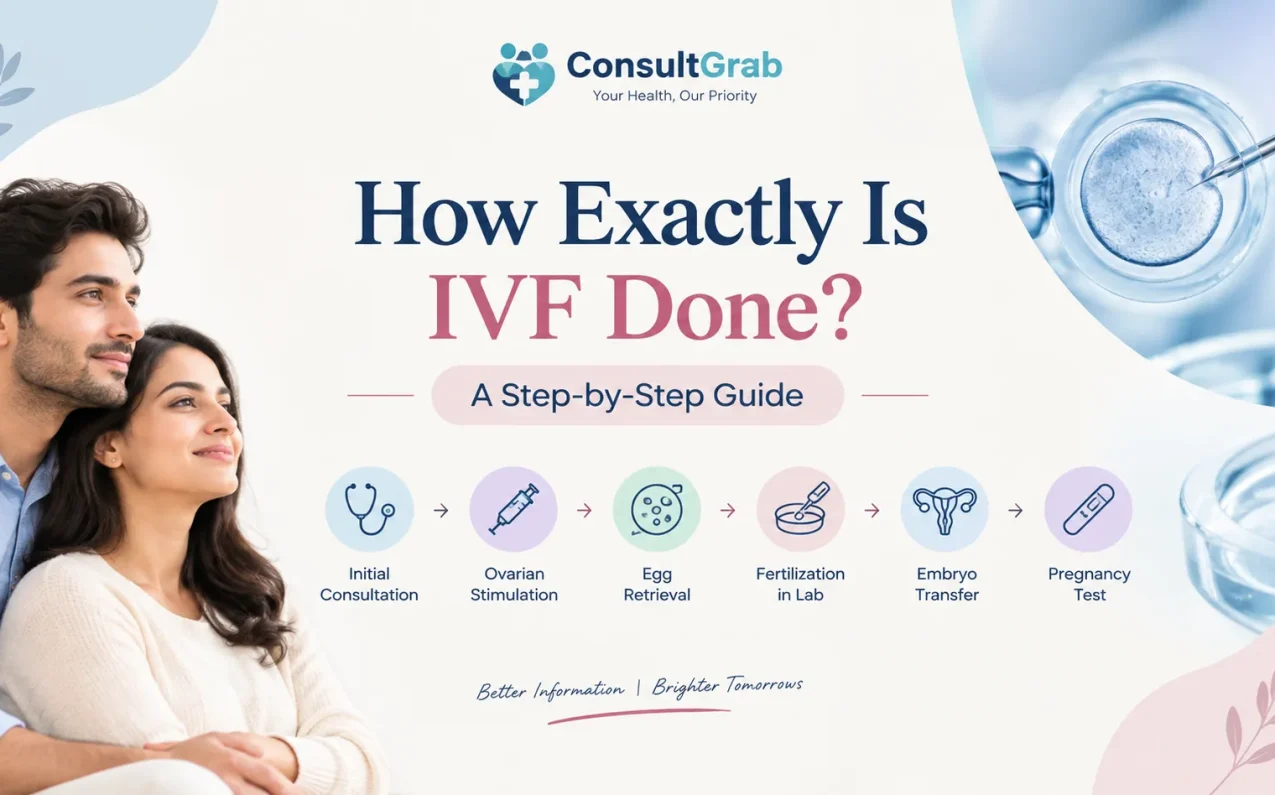
Direct answer: IVF (In Vitro Fertilisation) is a fertility treatment done in a fixed sequence of steps — starting with a baseline scan, followed by hormone injections, egg retrieval, fertilization in the lab, embryo transfer, and finally a pregnancy test.
- It is not a single procedure — it’s a process spread across several weeks
- Every step depends on how the body responds to the previous one
- The exact plan is personalized for each patient
Before jumping into IVF, many people first want to know if it’s even the right time for them.
Read More: When Should You Decide on IVF? Complete Fertility Guide
Start Your Parenthood Journey Today
Table of Contents
ToggleStep 1: The Baseline Ultrasound Scan
When does IVF actually begin?
It begins with a baseline TVS (trans-vaginal sonography) ultrasound.
- Done on day 2 or day 3 of the menstrual cycle
- Checks the ovaries for any cysts
- Measures the antral follicle count (the number of small follicles available that cycle)
Why does the follicle count matter?
It gives doctors a starting idea of how many eggs might be available for that IVF cycle.
Many patients ask what they should do physically before this stage even starts.
Read More: How to Prepare Body for IVF?
Step 2: Deciding the IVF Medicines and Dosage
How do doctors decide the injection dose?
The dosage is not the same for everyone — it’s based on several personal factors.
- Age
- AMH (a hormone level that reflects egg reserve)
- Antral follicle count from the scan
- Weight
- Overall medical history
Why does age affect the dosage?
Age influences how the ovaries are likely to respond to stimulation, so it’s one of the biggest factors doctors weigh in.
Read More: At What Age Is IVF Most Successful?
Step 3: The Injection Phase (Ovarian Stimulation)
How long do the injections continue?
Injections are usually given for around 9 to 10 days.
- The goal is to stimulate the ovaries to grow multiple follicles
- Regular ultrasound monitoring tracks follicle growth
- The dose can be adjusted mid-way depending on the response
If you’re wondering exactly how many injections this involves and why the number can vary, this is covered in detail separately.
Read More: How Many Injections Are Given During IVF Treatment? 2026 Guide
Step 4: The Trigger Shot and Egg Retrieval
What is a "trigger injection"?
It’s the final injection given once the follicles are mature and ready.
- It prepares the eggs for final maturation
- Egg retrieval is scheduled roughly 34–36 hours after this shot
- Retrieval is a timed procedure — the gap between trigger and retrieval matters
What happens on the retrieval day?
The male partner’s sperm sample is generally collected on the same day as egg retrieval.
Step 5: Fertilization in the Lab
How are the eggs fertilized?
The retrieved eggs are fertilized using either IVF or ICSI, depending on the case.
- IVF method: sperm and egg are placed together and fertilization happens naturally in a dish
- ICSI method: a single sperm is directly injected into the egg
- The choice between the two depends on individual fertility factors
What happens after fertilization?
The fertilized eggs are allowed to grow into embryos, sometimes up to the blastocyst stage (a more developed embryo stage before transfer).
Step 6: Embryo Transfer
Is embryo transfer a major surgery?
No — it’s generally a simple procedure.
- Anesthesia is usually not required
- The embryo can be transferred fresh, or frozen for a later Frozen Embryo Transfer (FET)
- Prescribed medicines are continued after the transfer to support the uterus
Step 7: The Pregnancy Test
When is the pregnancy confirmed?
A beta-hCG blood test is usually done around 12–14 days after the embryo transfer.
- This blood test confirms whether the embryo has implanted successfully
- Results and chances vary from person to person
- A fertility specialist can explain individual chances based on the specific case
How ConsultGrab Can Help With Your Fertility Journey
Going through IVF involves many decisions — from choosing the right specialist to understanding each stage of the process.
- ConsultGrab connects patients with experienced fertility specialists
- Each case is understood in detail before recommending a path forward
- Patients get clear explanations of treatment options at every step
- Support continues throughout the entire journey, so you’re never navigating it alone
ConsultGrab also assists patients exploring Surrogacy in India, guiding them through the medical and legal process with proper support.
Still Confused...... ??
Frequently Asked Questions
Around 9–10 days, with regular monitoring in between.
Roughly 34–36 hours after the trigger shot.
No, it's generally a simple procedure that doesn't need anesthesia.