

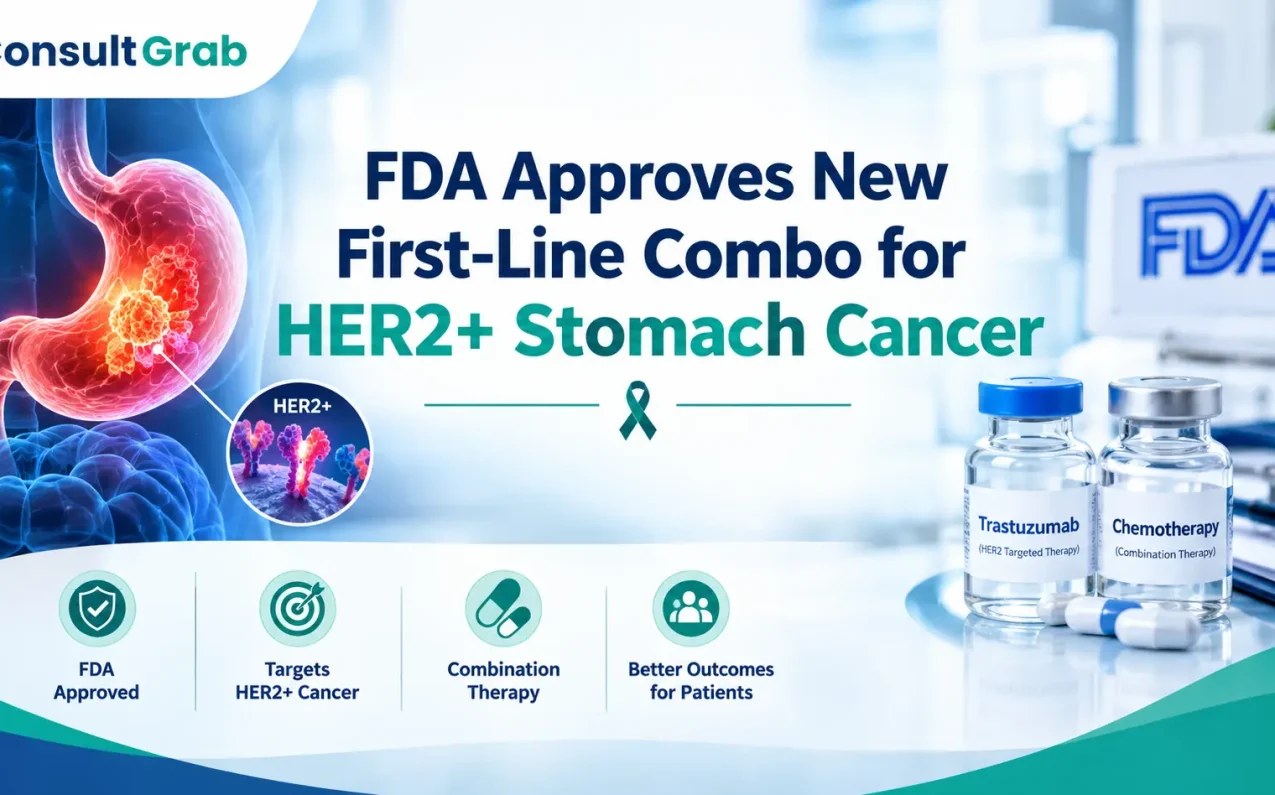
Stomach cancer, cancer at the junction where the food pipe meets the stomach, and adenocarcinoma of the food pipe are often treated as one family. Some of these tumours carry a protein called HER2, which can be targeted with specific medicines.
On 25 August 2026, the US Food and Drug Administration (FDA) approved zanidatamab (brand name Ziihera) as a first-line treatment for HER2-positive disease of this kind. It is approved in combination with chemotherapy, and with an immunotherapy medicine called tislelizumab.
This article explains what was approved, who it is for, and what it does not yet tell us. It is a US approval, so availability in India needs to be confirmed with your treating team.
Read More: Best Cancer Treatment in Delhi
Key Findings from the Research
Table of Contents
Toggle- The approval covers adults with HER2-positive cancer of the stomach, the stomach–food pipe junction, or the food pipe (adenocarcinoma type)
- It applies to disease that is locally advanced and cannot be removed by surgery, or that has spread
- In the main trial, the three-drug combination gave a median survival of 26.4 months, compared with 19.2 months for the older trastuzumab-based treatment
- Cancer control before growth resumed was also longer: 12.4 months versus 8.1 months
- The benefit was seen regardless of PD-L1 status, a marker doctors sometimes use to choose immunotherapy
How the Study Was Conducted
- The trial, called HERIZON-GEA-01, was a global phase 3 study with 914 patients in more than 30 countries
- Patients were randomly placed into three groups: trastuzumab plus chemotherapy (the comparison group), zanidatamab plus chemotherapy, or zanidatamab plus tislelizumab plus chemotherapy
- It was an open-label trial, meaning patients and doctors knew which treatment was given
- Results were published in the New England Journal of Medicine
What Did the Researchers Discover?
- New option, with numbers: the three-drug regimen lived longer on average than the older approach: 26.4 months versus 19.2 months
- Two approved routes: zanidatamab with chemotherapy and tislelizumab, and zanidatamab with chemotherapy alone. Company reporting also described a survival benefit for the chemotherapy-only combination
- What the medicines do: zanidatamab is a lab-made antibody that targets the HER2 protein. Tislelizumab is an immunotherapy that helps the immune system recognise cancer cells
- Compared with today’s standard: the older standard combines trastuzumab with chemotherapy, and adds pembrolizumab for some patients whose tumours have PD-L1
What This Means for Patients
- This is a regulatory approval based on a large trial, not experimental treatment. But it is a US approval
- It is for advanced or spread disease. It is not an approved treatment for early cancers that can be removed
- HER2 status must be confirmed by testing the tumour first. Only certain results, called IHC 3+ or IHC 2+ with a positive follow-up test, qualify
- Good to know:
- The trial was open-label, which can influence how results are reported
- Median survival is an average midpoint, not a promise for any one person
- Availability, approval, and cost in India need to be checked with your treating team
- Cancer treatment has side effects, and the oncologist should explain them for your situation
Read More: Gallbladder Cancer in North India: Why the Risk Is Higher
When to Speak With a Specialist
It is worth asking an oncologist if you or a family member:
- Has been diagnosed with advanced or metastatic cancer of the stomach, stomach–food pipe junction, or food pipe
- Has not yet had HER2 testing, or is unsure of the result
- Is being offered trastuzumab-based treatment and wants to know how newer options compare
- Wants to know whether a newer medicine can be accessed in India
- Would like a second opinion on the treatment plan
Future Research and Next Steps
- Researchers will keep following patients to see how long benefits last
- Studies are looking at where zanidatamab fits in earlier stages, including before surgery
- Questions remain about which patients benefit most, and how the regimen compares in different regions
Conclusion
The August 2026 approval adds a new first-line option for HER2-positive advanced stomach and food-pipe cancers. The trial results are encouraging, but they apply to a specific group and to a US approval. The most useful next step is to confirm HER2 status and discuss options with an oncology team.
How ConsultGrab Helps You
A cancer diagnosis brings many decisions. ConsultGrab supports patients with:
- Understanding your case in detail and explaining treatment options clearly
- Connecting you with trusted oncologists and treatment options
- Help comparing options and preparing questions for your doctors
- Support throughout the process, so you never feel alone
Read More: What Is the Best Diet for Cancer Patients? Healthy Plan Now
Medical Disclaimer: This article is for educational purposes only and is not a substitute for professional medical advice, diagnosis, or treatment.
Frequently Asked Questions (FAQs)
On 25 August 2026, the FDA approved zanidatamab (Ziihera) with chemotherapy, with or without tislelizumab, as first-line treatment for HER2-positive advanced stomach, gastroesophageal junction, or food-pipe adenocarcinoma. It is for cancer that cannot be removed or has spread.
HER2 is a protein on the surface of some cancer cells. A tumour is HER2-positive when testing shows high levels of it. Doctors check this on tumour tissue, and only certain test results qualify for these medicines.
In HERIZON-GEA-01, median survival was 26.4 months with zanidatamab, tislelizumab, and chemotherapy, versus 19.2 months with trastuzumab and chemotherapy. Median is a midpoint across patients, so it does not predict how any one person will do.
No. The approval covers advanced disease that cannot be removed by surgery, or has spread. Its role in earlier stages is still being studied.
The approval is from the US FDA. Whether it is approved, available, and affordable in India needs to be confirmed with your oncology team or treating hospital.
Original Research Source
This article is based on findings from a scientific research study, a regulatory approval, and related media reporting.
Primary Research: HERIZON-GEA-01, New England Journal of Medicine (DOI: 10.1056/NEJMoa2517729)
Media Coverage: Oncology News Central · Medscape · CancerNetwork
The content has been independently rewritten, analyzed, and simplified for educational purposes to help patients and families better understand the research findings.