

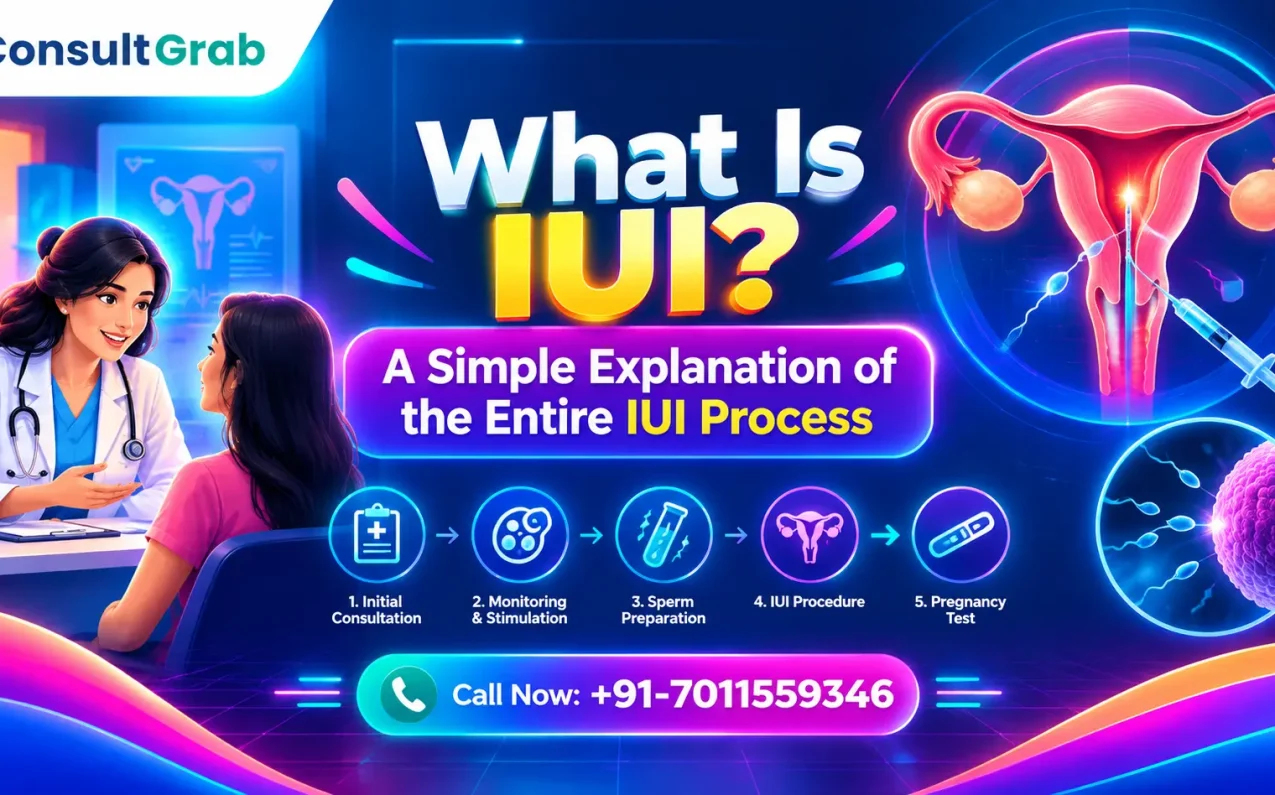
IUI (Intrauterine Insemination) is a fertility procedure where prepared sperm is placed directly inside the uterus, timed around ovulation, to improve the chances of pregnancy.
What Does IUI Mean?
Table of Contents
ToggleIUI stands for Intrauterine Insemination.
- “Intrauterine” means inside the uterus.
- “Insemination” means placing sperm into the body to assist conception.
- In Hindi, this is sometimes referred to as “गर्भाशय में शुक्राणु प्रत्यारोपण” — the same procedure, just described in Hindi.
In simple words, IUI is a way of placing sperm closer to the egg than it would naturally travel, at exactly the right time — increasing the chance that fertilization happens.
Why Is IUI Done?
Couples usually try to conceive naturally first — having intercourse around ovulation, when the egg is released.
IUI is often recommended when:
- Natural attempts haven’t led to pregnancy after some time.
- Timing needs to be more precise than natural attempts allow.
- Mild fertility issues are involved, and a small boost can help.
The main goal of IUI is simple: place healthy sperm inside the uterus at exactly the right moment, so pregnancy chances improve.
How Does IUI Work? The Basic Idea
IUI works by removing the guesswork around timing.
- In a natural cycle, you don’t always know the exact moment an egg is released.
- With IUI, doctors monitor your cycle closely and can predict ovulation almost to the hour.
- Sperm is then placed in the uterus right around that predicted time — giving it the best possible chance to reach the egg.
The IUI Procedure — Step by Step
Step 1: Follicular Monitoring
Before anything else, your clinic tracks your cycle through ultrasounds.
- These scans check if your eggs are maturing properly.
- They also check if your uterus lining is ready to support a pregnancy.
- This is usually done every few days as your cycle progresses.
Step 2: The Trigger Shot
Once the egg and lining look ready, a “trigger shot” is given.
- This injection causes the egg to release in a predictable way — usually about 36 hours later.
- Without it, egg release timing can’t be predicted, making it hard to plan the exact insemination time.
- The trigger shot also supports the uterus with hormones that help pregnancy along.
- Timing this injection correctly is important — not too early, not too late — and your clinic will guide you on exactly when to come in next.
Related Guide
Is IUI Painful? What to Really Expect — many clinics use soft, fine instruments specifically to keep this part of the process as comfortable as possible.
Step 3: Sperm Collection and Preparation
On the day of the procedure:
- A semen sample is collected in a private room at the clinic.
- The sample is checked under a microscope — for example, a sample might show a certain percentage of actively moving sperm and the rest inactive.
- The lab then separates the healthy, active sperm from inactive or dead sperm, and removes anything that shouldn’t enter the uterus.
- Only the cleaned, concentrated sample of healthy sperm is used for the procedure.
Step 4: The Insemination
The prepared sperm is loaded into a thin catheter and gently placed into the uterus.
- The catheter used is very fine and flexible.
- Some clinics use ultrasound guidance during this step, to confirm the catheter is positioned correctly.
- The sample is pushed in slowly, not quickly — this helps it stay in place and move naturally toward the fallopian tubes, where the egg is waiting.
Step 5: Rest and Aftercare
After the procedure, you’ll typically rest at the clinic for 15–20 minutes before going home.
You’ll also usually be given about 15 days of medication to help prepare the uterus for pregnancy, along with clear do’s and don’ts for this period.
Related Guide
What Happens After IUI? Day-by-Day Guide — for a full breakdown of what to expect during those 15 days.
Start Your Parenthood Journey Today
Single vs. Double IUI
Not every clinic follows the exact same schedule.
- Some clinics perform a single IUI — one insemination per cycle.
- Others perform a double IUI — two inseminations within the same cycle, spaced a day or two apart.
- Your clinic will explain which approach they recommend and why, based on your specific case.
Egg and Follicle Monitoring During IUI
Doctors track follicle growth through the ultrasounds mentioned earlier, since this tells them when your eggs are ready.
- Monitoring helps confirm egg maturity before the trigger shot is given.
- If more than one mature follicle develops in a cycle, the chances of a multiple pregnancy (like twins) can go up — your doctor will discuss this with you based on your own monitoring results.
- Exact follicle counts and targets vary from patient to patient, which is why this is tracked individually rather than following a fixed number for everyone.
After IUI — Medication and the Pregnancy Test
Once the procedure is done, the next two weeks matter just as much as the procedure itself.
- You’ll be given medication (usually for about 15 days) to support the uterus.
- Your clinic will walk you through specific do’s and don’ts for this period.
- After the 15 days, you can take a simple urine pregnancy test at home — usually first thing in the morning, for the most accurate result.
Every patient’s situation is different, so your clinic will also discuss your personal success rate and next steps based on your specific case.
Is IUI Safe? Common Questions Answered
Is IUI a safe procedure? Yes. IUI is a well-established, non-surgical procedure. Clinics use soft, fine instruments and a slow, careful technique specifically to keep the process safe and comfortable.
Are babies conceived through IUI normal? Yes. IUI simply places sperm closer to the egg at the right time — fertilization and pregnancy still happen naturally inside the body, the same way they would without assistance. It isn’t a lab-based procedure like IVF.
IUI vs. IVF — What's the Difference?
IUI and IVF are both fertility treatments, but they work very differently.
- IUI: Sperm is placed inside the uterus, and fertilization happens naturally inside the body.
- IVF: Eggs are retrieved and fertilized in a lab, and the resulting embryo is placed back into the uterus.
IUI is generally the simpler, less invasive option and is often tried first.
Related Guide
IVF vs IUI — Which Fertility Treatment Is Better? for a full comparison.
Planning for IUI? Know the Costs Involved
Understanding the procedure is the first step — knowing what it costs helps you plan the journey ahead.
Related Guide
IUI Treatment Cost in India (2026) — Complete Pricing Guide for a full, city-wise price breakdown.
IUI in India Today
IUI is increasingly available beyond major metro cities. Hospitals in smaller states and cities across India have been successfully performing IUI-assisted deliveries, reflecting how accessible this treatment has become — not just in large private fertility chains, but in a growing number of hospitals nationwide.
Frequently Asked Questions (FAQs)
IUI (Intrauterine Insemination) is a fertility procedure where prepared sperm is placed directly inside the uterus, timed around ovulation, to improve the chances of pregnancy.
It's a non-surgical fertility treatment involving cycle monitoring, a trigger shot, sperm preparation, and insemination — all aimed at improving natural conception chances.
IUI means Intrauterine Insemination — placing sperm inside the uterus to assist conception.
Through follicular monitoring, a trigger shot to time ovulation, sperm collection and preparation, and finally placing the prepared sperm into the uterus using a thin catheter.
It's usually recommended when natural attempts haven't worked, when precise timing is needed, or when mild fertility issues are involved.
Both are fertility treatments. IUI places sperm in the uterus for natural fertilization; IVF fertilizes the egg in a lab before placing the embryo in the uterus.
The exact amount varies by sample, but what matters most is the concentration of healthy, active sperm after lab preparation — not the total volume collected.
A semen sample is collected in a private room at the clinic, then analyzed and processed in the lab to separate healthy, active sperm before the procedure.
Yes, IUI is a safe, non-surgical, well-established fertility procedure.
Yes. Since fertilization happens naturally inside the body, babies conceived through IUI develop the same way as any naturally conceived pregnancy.