

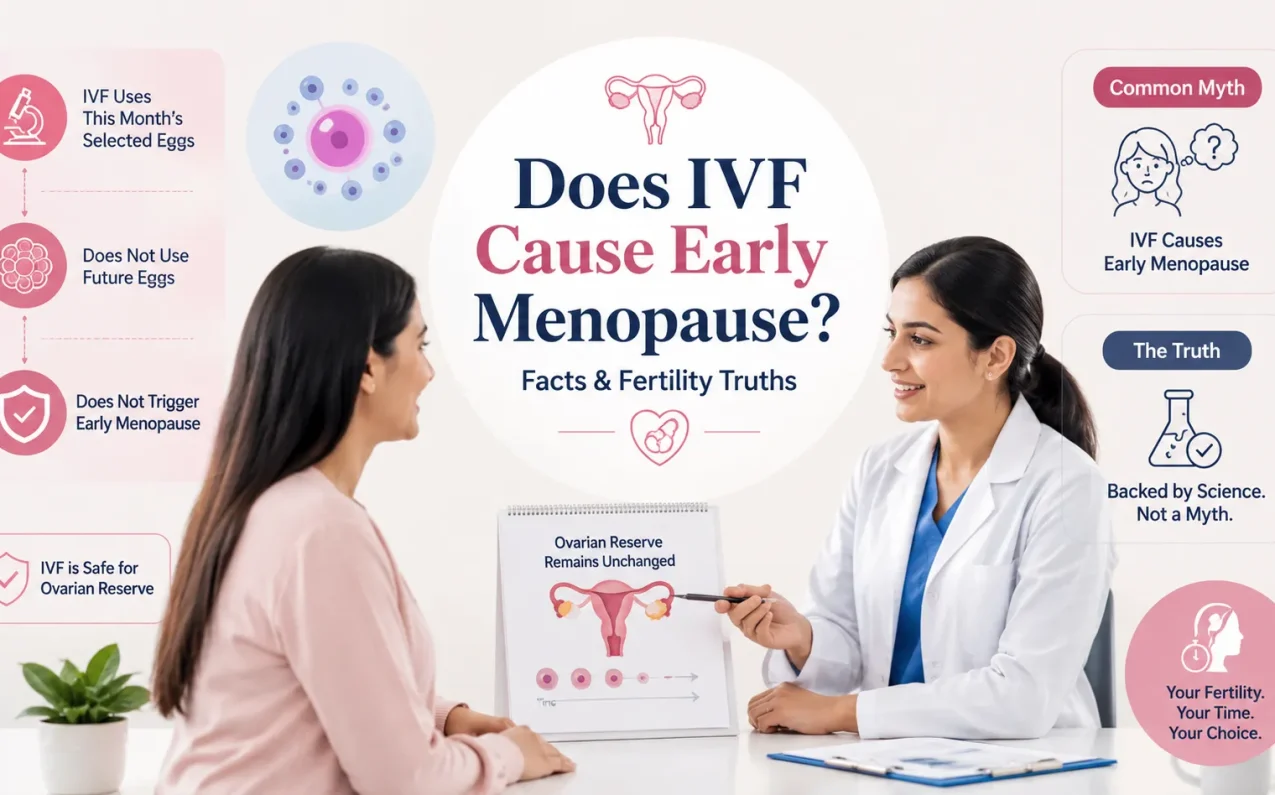
A common concern among women considering IVF treatment is whether retrieving multiple eggs during the procedure can lead to early menopause.
This question has gained even more attention recently due to viral discussions on social media and podcasts, where claims suggested that IVF treatment could trigger menopause earlier than expected. Such statements have understandably created anxiety among couples already navigating fertility challenges.
However, understanding how the ovaries naturally function helps clarify why this belief is a misconception.
The reality is that IVF does not cause early menopause. For individuals seeking personalized fertility guidance, consulting with the best IVF doctors in Delhi can help address concerns about egg retrieval, ovarian reserve, and long-term reproductive health based on scientific evidence rather than myths. Fertility specialists can also explain how IVF treatment works and what impact, if any, it has on future fertility.
While IVF treatment involves collecting multiple eggs in a single cycle, it does not accelerate the natural depletion of a woman’s egg reserve. Instead, it utilizes eggs that have already been selected by the body for that month’s cycle.
Let’s explore the science behind IVF, egg retrieval, and menopause.
Why Do People Believe IVF Causes Early Menopause?
Table of Contents
ToggleThe concern often comes from a simple assumption.
Many people believe that only one egg develops each month and is released during ovulation. Therefore, when they hear that IVF treatment may involve retrieving 10 to 15 eggs—or sometimes even more—in a single cycle, it can seem as though several months’ worth of eggs are being used at once.
This naturally raises questions such as:
- Will my egg reserve decrease faster?
- Am I using up future eggs?
- Could IVF make me reach menopause earlier?
These concerns are understandable, but they are based on a misunderstanding of how ovarian biology works.
Understanding a Woman's Natural Egg Supply
A woman is born with all the eggs she will ever have.
The number of eggs changes throughout life:
- During fetal development, the ovaries contain the highest number of eggs.
- By birth, the egg count naturally decreases.
- By puberty, approximately 400,000 eggs remain in the ovaries.
Interestingly, throughout a woman’s entire reproductive lifespan—from puberty until menopause—only about 400 eggs will actually be released through ovulation.
The vast majority of eggs never ovulate. Instead, they naturally disappear as part of the body’s normal biological process.
This natural decline occurs regardless of whether a woman becomes pregnant, undergoes fertility treatment, or never attempts conception.
What Happens During a Normal Menstrual Cycle?
A common myth is that the body prepares only one egg each month.
In reality, during every menstrual cycle, a group of eggs begins developing within the ovaries.
The body naturally recruits multiple eggs, often around 15 to 20, during a cycle. However, only one egg typically becomes dominant and reaches ovulation.
The remaining eggs in that group stop developing and are naturally lost.
This process happens every month throughout the reproductive years.
In other words, the body already selects multiple eggs each cycle, even though only one is eventually released.
How IVF Changes the Process
IVF does not recruit eggs from future months or years.
Instead, fertility medications support the growth of the eggs that have already been selected by the body for that specific cycle.
Normally, one egg matures while the others are lost.
During IVF treatment, hormone medications help more of these already-selected eggs continue growing and reaching maturity.
Once mature, these eggs are retrieved and used for fertilization. For couples planning fertility treatment, understanding both the medical process and the IVF treatment cost in India can help them make informed decisions about their fertility journey. Knowing what to expect financially is often an important part of preparing for IVF treatment.
The key point is that IVF works with the month’s existing group of eggs rather than taking eggs that would have been available in future cycles.
Does Egg Retrieval Reduce Your Future Egg Reserve?
This is one of the most important questions patients ask.
The answer is no.
The eggs collected during IVF are generally the same eggs that would have naturally disappeared during that menstrual cycle if fertility medications had not been used.
Rather than consuming future eggs, IVF allows fertility specialists to make use of eggs that would otherwise be lost.
This means that IVF does not significantly reduce the total number of eggs remaining in the ovaries beyond what would naturally occur.
Why Is This Myth Trending Again?
Recent online discussions have revived concerns about IVF and menopause.
One reason this misconception spreads is that some women undergoing fertility treatment are already experiencing age-related fertility decline. Fertility evaluations may reveal a lower ovarian reserve, which can make it appear as though IVF caused the problem when, in reality, the underlying decline already existed.
Another source of confusion involves temporary side effects of fertility medications.
Some women may experience:
- Hot flashes
- Sleep disturbances
- Mood changes
- Vaginal dryness
- Hormonal fluctuations
These symptoms can resemble those experienced during perimenopause or menopause.
However, experiencing temporary hormonal symptoms does not mean menopause has begun.
The hormonal changes associated with fertility treatment are temporary and different from the permanent biological changes that occur during menopause.
Can IVF Reveal Existing Fertility Decline?
In some cases, IVF testing may identify women who already have a lower ovarian reserve.
During fertility assessments, specialists evaluate how the ovaries respond and estimate the number of eggs available.
If ovarian reserve is already reduced, fertility testing may bring this information to light.
This can create the impression that IVF caused declining fertility when, in fact, the treatment simply helped identify a condition that already existed.
For some women, fertility treatment becomes the first time they receive detailed information about their reproductive health.
What Actually Causes Early Menopause?
Several factors may increase the likelihood of early menopause, including:
- Family history of early menopause
- Certain genetic conditions
- Autoimmune disorders affecting ovarian function
- Smoking
- Chemotherapy
- Pelvic radiation therapy
These factors can impact ovarian function and egg supply.
IVF treatment itself is not considered a cause of early menopause.
Does IVF Cause Early Menopause? The Final Answer
Based on current understanding of ovarian biology, the answer is clear:
No, IVF does not cause early menopause.
Retrieving multiple eggs during IVF does not mean future eggs are being used up.
The treatment works by helping mature eggs that were already selected for that month’s cycle. Many of these eggs would have naturally stopped developing and disappeared if IVF had not been performed.
As a result, IVF does not accelerate menopause or significantly shorten reproductive lifespan.
Why Accurate Fertility Information Matters
Fertility treatment decisions can feel overwhelming, especially when conflicting information circulates online.
Unfortunately, myths about IVF can create unnecessary fear and may discourage some couples from exploring treatment options that could help them achieve parenthood.
Understanding the science behind fertility treatments allows patients to make informed decisions based on facts rather than misconceptions.
Every fertility journey is unique, and personalized medical guidance remains essential when evaluating treatment options.
How ConsultGrab Supports Your Fertility Journey
At ConsultGrab, we understand that fertility treatment involves important medical and emotional decisions.
Our role is to help patients access trusted fertility specialists, understand available treatment options, and receive transparent guidance throughout the process.
Our care team can assist with:
- Connecting patients with experienced fertility experts
- Understanding IVF and fertility treatment options
- Appointment booking assistance
- Treatment planning support
- Cost and treatment comparisons
- Guidance throughout the parenthood journey
We believe every patient deserves clear information, expert support, and confidence when making healthcare decisions.
Conclusion
The belief that IVF causes early menopause is a persistent fertility myth that continues to resurface in online discussions.
While IVF treatment involves retrieving multiple eggs during a single cycle, these eggs are not taken from future fertility reserves. Instead, they come from the group of eggs that the body had already selected for that month’s cycle—many of which would otherwise have been naturally lost.
For this reason, IVF does not trigger early menopause or accelerate the natural decline of ovarian function.
If you are considering IVF and have concerns about your fertility, ovarian reserve, or treatment options, consulting experienced fertility specialists can help you understand your individual situation and make informed decisions with confidence. It is also important to understand when to decide on IVF treatment, as factors such as age, fertility diagnosis, and the duration of trying to conceive can influence the timing of treatment and its potential success.
Frequently Asked Questions (FAQs)
No, IVF does not cause early menopause. During IVF treatment, fertility medications help mature eggs that have already been selected for that menstrual cycle. These eggs would otherwise be naturally lost. IVF does not use up future eggs or significantly reduce ovarian reserve, so it does not accelerate menopause.
No, egg retrieval does not significantly reduce a woman's egg reserve. IVF collects eggs from the group naturally recruited during that month's cycle. Many of these eggs would not have ovulated and would have disappeared naturally. The procedure does not remove eggs that would be used in future menstrual cycles.
This misconception often arises because IVF involves retrieving multiple eggs in one cycle and because some fertility medications can cause temporary symptoms such as hot flashes, mood changes, or sleep disturbances. These effects may resemble menopause symptoms, but they do not indicate that IVF has caused menopause
Yes, IVF testing and fertility evaluations can identify a low ovarian reserve that may have already existed before treatment. Fertility specialists assess how the ovaries respond to stimulation and estimate egg quantity. IVF does not cause a low ovarian reserve; it may simply help detect an existing fertility condition.
Several factors may increase the risk of early menopause, including family history, certain genetic conditions, autoimmune disorders, smoking, chemotherapy, and pelvic radiation therapy. These factors can affect ovarian function and egg supply. Current evidence does not support IVF treatment as a cause of early menopause.