

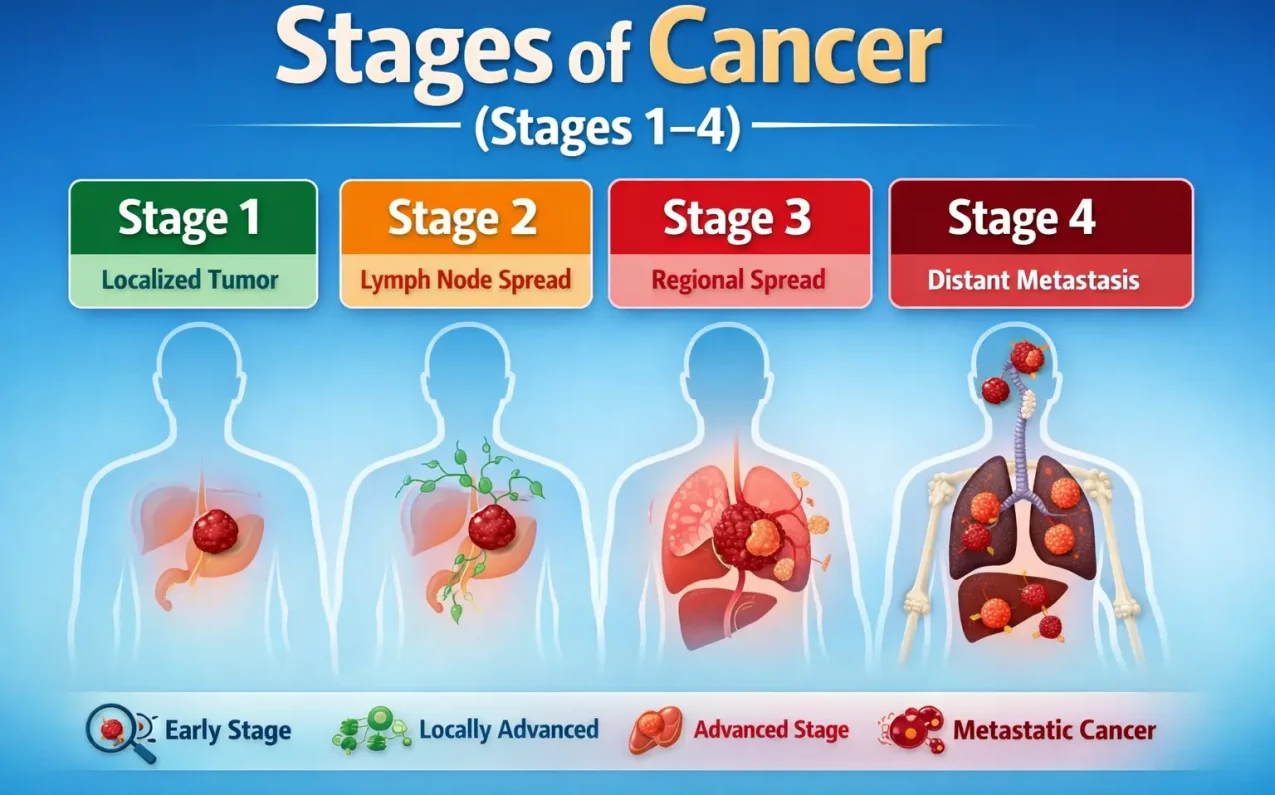
For patients and their families dealing with a cancer diagnosis, it is essential to comprehend the Stages of Cancer (Stages1-4). Cancer staging provides information about prognosis, aids in treatment planning, and establishes the extent to which the cancer has spread. Staging is crucial in medical decision-making, regardless of the type of cancer—breast, lung, colon, or any other.
To understand the disease better and learn more about how it develops, you can visit the What is Cancer blog and visit Cancer Treatment.
We will go over each step in depth, explain how staging operates, and go over treatment alternatives that are frequently advised at various stages in this comprehensive guide.
Cancer Staging: What Is It?
Table of Contents
ToggleThe process of figuring out how big a tumour is and how far it has progressed throughout the body is known as cancer staging. Doctors use various diagnostic tools—including physical exams, imaging tests (like CT scans and MRIs), and biopsies—to assign a stage. The most common system used is the TNM system:
- T (Tumor): The size and extent of the primary tumor.
- N (Node): Whether the cancer has spread to nearby lymph nodes.
- M (Metastasis): Whether the cancer has spread to distant parts of the body.
By combining these factors, doctors categorize the cancer into stages 1 through 4.
Understanding the TNM Staging System
The TNM system looks at three main things:
- T – Tumor: How big the main tumor is or how far it has grown into nearby tissue
- N – Nodes: If cancer has spread to nearby lymph nodes
- M – Metastasis: If cancer has spread to other organs
Based on the TNM results, cancer is grouped into Stage 1, 2, 3, or 4.
Stage 1 Cancer – Early Stage
Stage 1 is often called early-stage cancer. At this point:
- The tumor is small
- Cancer is only in its original spot
- It has not spread to lymph nodes or other organs
Common Characteristics:
- Usually easy to treat
- Often handled with just surgery
- Might not cause any clear symptoms
How It’s Treated:
- Surgery to remove the tumor
- Radiation (sometimes)
- Targeted therapy, depending on the cancer
Finding cancer early through screening is very important for catching it at Stage 1.
Stage 2 Cancer: Local Spread
In stage 2, the tumor is bigger than in stage 1 and might have moved to nearby lymph nodes, but it’s still in the same general area as where it started.
Common Characteristics:
- The tumor is a moderate size.
- It has spread a bit in the region.
- It needs stronger treatment than stage 1.
Treatment could involve:
- Surgery
- Chemotherapy
- Radiation
- A mix of treatments
If caught and treated quickly, stage 2 cancers often have good survival rates.
Stage 3 Cancer: Regionally Advanced
Stage 3 cancer is a bit more advanced.
- Tumor is bigger.
- It has spread to nearby lymph nodes.
- It hasn’t spread to distant organs.
Common Characteristics:
- Lymph nodes are really involved.
- Higher chance of the cancer coming back.
- Needs several kinds of treatment.
Treatment choices:
- Surgery (if possible)
- Chemotherapy
- Radiation
- Immunotherapy
- Targeted therapy
Treatment plans at this stage are usually more involved and need careful coordination by cancer experts.
Stage 4 Cancer: When Cancer Spreads
Stage 4 is the most advanced cancer stage, meaning it has spread to other parts of your body.
Where It Spreads:
It often goes to the liver, lungs, brain, and bones.
Common Characteristics:
- It affects your whole body.
- Symptoms might be worse.
- Treatment aims to manage it and improve your life quality.
Treatment Options:
- Chemotherapy
- Immunotherapy
- Targeted therapy
- Hormone therapy
- Palliative care
Even though Stage 4 cancer is serious, treatments have come a long way, helping people live longer.
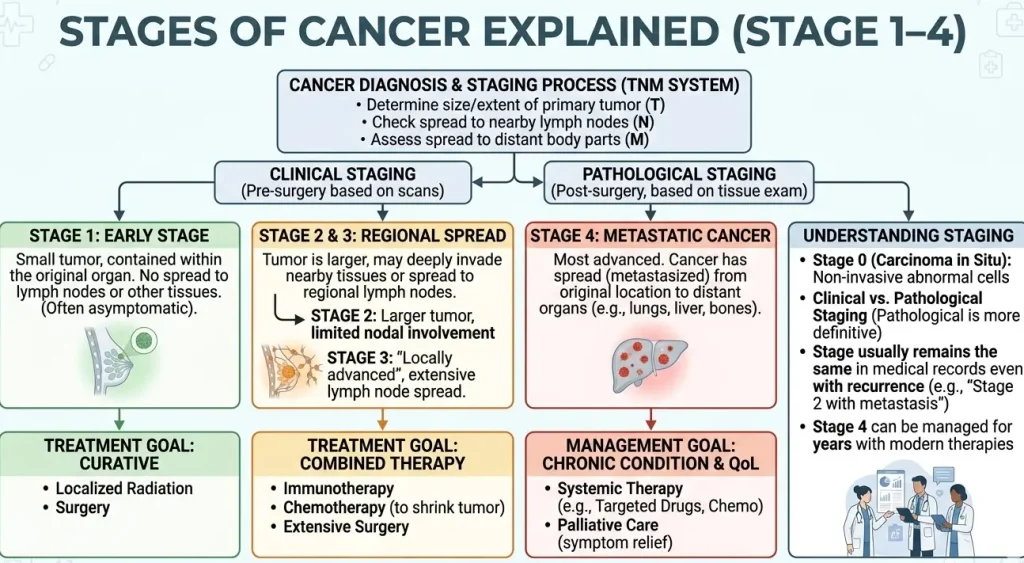
How Staging Guides Treatment
The stage of cancer really matters because it helps decide:
- Which treatments to use
- How long treatment lasts
- How intense it is
- How quickly you might recover
- Your chances of survival
For instance: Early cancer (Stages 1–2) might just need surgery. Later stages (3–4) usually need a mix of treatments.
Each treatment plan fits the person, looking at the stage, age, general health, and type of cancer.
Survival Rates and Prognosis by Stage
Survival rates usually go down as the cancer stage goes up. But, it depends on:
- The type of cancer
- The person’s health
- How well treatment works
- What treatments are available
Finding cancer early can really improve your chances. That’s why check-ups and knowing the symptoms are so important
Importance of Early Detection
Tests like mammograms, colonoscopies, Pap smears, and CT scans can spot cancer early.
- Finding it early means:
- Less intense treatment
- Better chances of recovery
- Lower medical bills
- Better life quality
If you have ongoing symptoms like losing weight without trying, a cough that won’t quit, unusual bleeding, or lumps, see a doctor ASAP.
When to Consult a Specialist?
If you or a loved one has been diagnosed with cancer, consulting an oncology specialist is essential for accurate staging and treatment planning.
For expert guidance and personalized treatment plans, you can visit:
- Home: https://www.consultgrab.com/
- About Us: https://www.consultgrab.com/about-us/
- Contact Us: https://www.consultgrab.com/contact-us/
Early consultation improves treatment success rates.
How Consult Grab Helps You Choose the Best Cancer Treatment In Delhi?
Finding the right cancer treatment center and doctor can be hard, especially when your health and time are on the line. Consult Grab makes this process easier by giving patients in Delhi and the surrounding areas personalised advice and expert help. People can do the following with Consult Grab:
- Connect with Top Oncologists in Delhi: You can find highly qualified cancer specialists who can help you with your specific type of cancer and treatment needs.
- Compare Treatment Options: Learn about the differences between hospitals, therapies (like surgery, chemotherapy, radiation, and immunotherapy), and what you can expect from each one.
- Get Personalised Help: Get help with making appointments, getting ready for consultations, and understanding treatment plans so you can make smart choices.
- Consult Grab makes the whole process easier, from getting expert advice to setting up appointments. This lets you focus on your health and recovery.
Disclaimer
The information provided in this article is generated for informational purposes only. The content is created with the help of general medical knowledge and data available on the internet. It should not be considered as professional medical advice, diagnosis, or treatment. Always consult a qualified healthcare professional or specialist for proper medical guidance and personalized treatment recommendations