


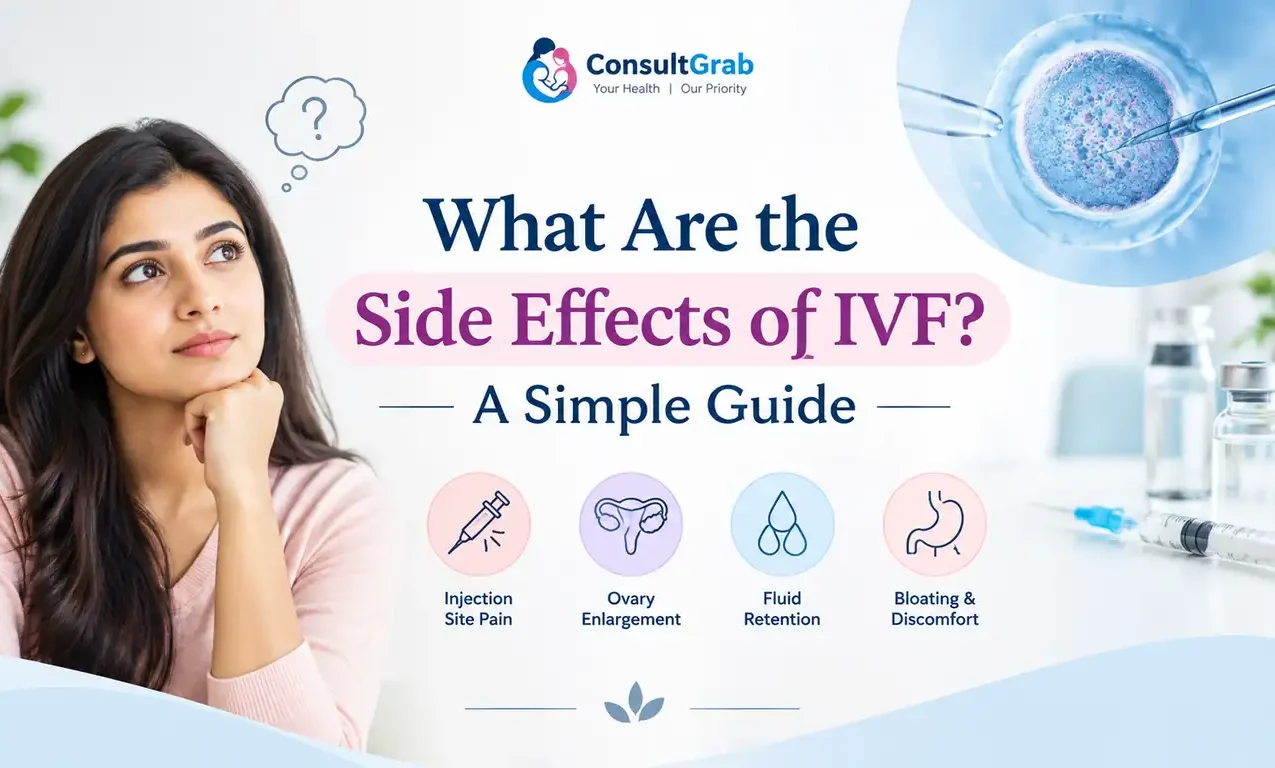
What Are the Side Effects of IVF?
Table of Contents
ToggleShort answer: The main side effects of IVF are pain at the injection site, bloating, and a heavy feeling in the belly.
- IVF (in vitro fertilization) is a fertility treatment where an egg and sperm meet outside the body.
- Most side effects come from the injections used during treatment.
- Knowing them before you start helps you feel prepared.
Read More: At what age is IVF most successful?
Start Your Parenthood Journey Today
Quick Summary: IVF Side Effects at a Glance
- Injection site pain: Pain or mild discomfort where the injection is given.
- Ovary enlargement: The ovaries grow bigger while making eggs.
- Water retention: Extra fluid can collect in the body.
- Belly symptoms: Heaviness, swelling, or discomfort in the stomach area.
- OHSS: A stronger reaction of the ovaries. It is called ovarian hyperstimulation syndrome.
Why Does IVF Cause Pain at the Injection Site?
Short answer: IVF treatment uses injections, and these can cause pain or mild discomfort where the needle goes in.
- The injections are part of the treatment plan.
- The discomfort is usually mild.
- It is one of the first side effects people notice.
Read More: How Many Injections Are Given During IVF Treatment? 2026 Guide
Why Do the Ovaries Get Bigger During IVF?
Short answer: In IVF, the ovaries are stimulated to make eggs, and this makes them grow in size.
- Ovaries are the organs that hold and release eggs.
- Injections push them to make eggs.
- A bigger ovary is a normal effect of this stimulation.
Why Do You Feel Bloated or Heavy During IVF?
Short answer: Larger ovaries and extra water in the body can cause bloating, heaviness, and discomfort in the belly.
- Bigger ovaries can make the belly feel full.
- The body may hold more water than usual.
- This can feel like swelling or heaviness in the stomach.
What Is OHSS in IVF?
Short answer: OHSS stands for ovarian hyperstimulation syndrome. It is a risk linked to over-stimulated ovaries.
- The ovaries become larger because of the injections.
- The body may also hold extra water.
- The risk can be lowered with careful planning.
Can the Side Effects of IVF Be Reduced?
Short answer: Yes. Doctors have several ways to lower the risk, especially for ovary over-stimulation.
- Many techniques are available for prevention and treatment.
- Your doctor can change the injections or the treatment plan.
- The right choice depends on your situation.
Read More: How to prepare body for IVF?
How Do Doctors Lower the Risk of OHSS?
1. Changing the injections and treatment plan
- The type of injection can be changed.
- The treatment plan (called a protocol) can be adjusted.
- Both steps help lower the risk.
2. Using alternative injections
- In some cases, doctors use a different injection.
- This makes over-stimulation of the ovaries less likely.
3. Freezing all good embryos
- An embryo is a fertilized egg that has started to grow.
- Instead of a transfer in the same cycle, all good embryos are frozen.
- The transfer is done in a later cycle, once the ovaries return to normal size.
Result: This approach can greatly lower the chance of OHSS.
Who Should Know About IVF Side Effects Before Starting?
Short answer: Anyone planning IVF should learn about side effects first.
- It helps you know what is normal.
- It helps you ask your doctor the right questions.
- It makes the treatment journey less stressful.
Read More: When Should You Decide on IVF? Complete Fertility Guide
Still Confused...... ??
How Can ConsultGrab Help?
ConsultGrab connects patients with trusted medical specialists. We help you understand your case and your options clearly.
- We understand each case in detail.
- We connect you with relevant specialists.
- We explain treatment options in simple words.
- We support you through the whole process.
For families exploring surrogacy in India, our fertility specialists guide you with proper medical and legal support.
Frequently Asked Questions (FAQs)
The main ones are injection site pain, bigger ovaries, water retention, bloating, and a heavy belly .
They can cause pain or mild discomfort at the injection site.
The ovaries grow larger and the body may hold extra water, which causes heaviness and swelling in the belly.
OHSS is ovarian hyperstimulation syndrome, a risk linked to over-stimulated ovaries during IVF.
Its risk can be greatly reduced by changing injections or protocols, or by freezing embryos for a later transfer.
It delays the transfer until the ovaries return to normal size, which lowers the chance of OHSS.
Yes. In some cases, doctors use injections that make over-stimulation less likely
Yes. Knowing them early helps you prepare and plan with your doctor.


1 Comment
How Long Does IVF Take to Get Pregnant? What Affects Your Chances
[…] Read More: What are the side effects of IVF? […]