
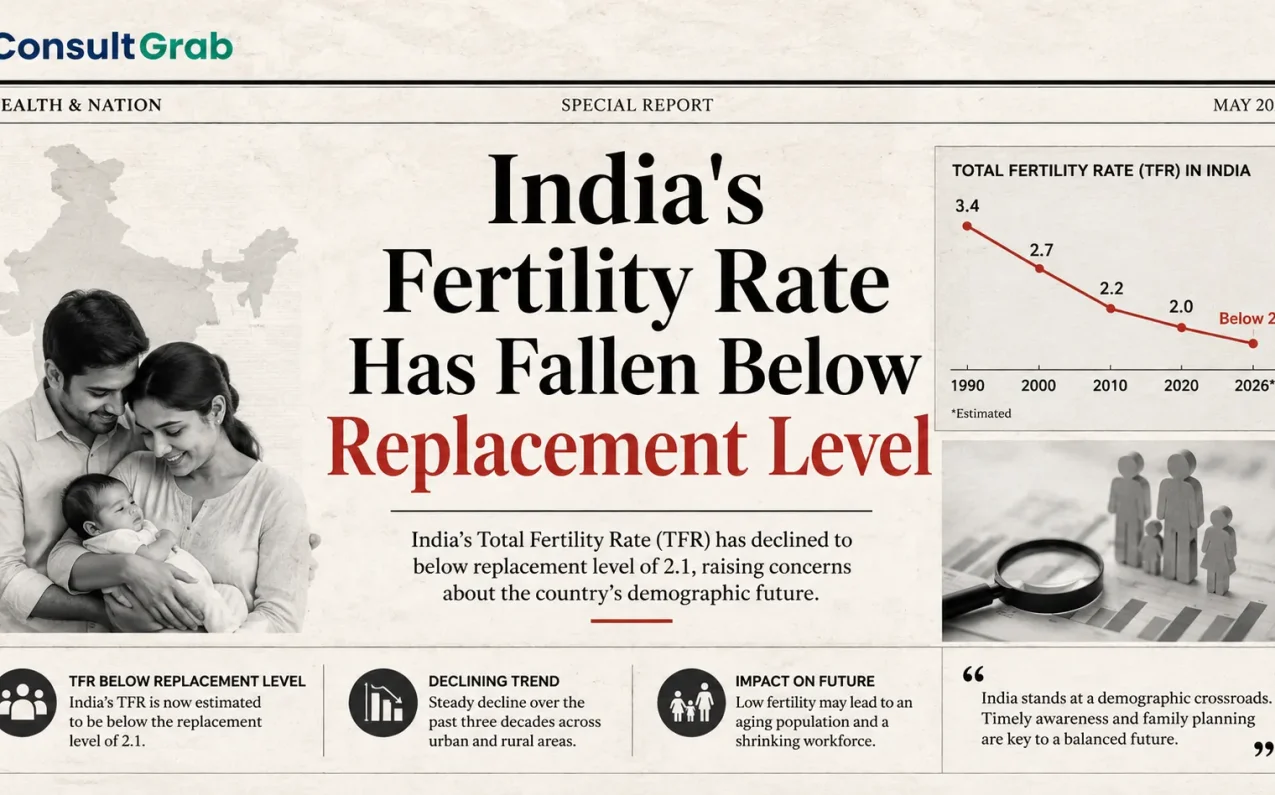
For decades, India has been widely associated with rapid population growth. But newer government data tells a more layered story. As of the latest official figures, India’s Total Fertility Rate (TFR) — the average number of children a woman is expected to have in her lifetime — has fallen to 1.9. That’s below the “replacement level” of 2.1, the rate needed for a population to remain stable across generations without migration.
This isn’t a one-year blip. It’s part of a pattern seen worldwide, from South Korea to Japan to Italy, where economic development and rising education levels have consistently led to smaller families over time. Understanding where India stands in this pattern — and how sharply it varies across states — matters for anyone thinking about family planning, reproductive health, or fertility care.
Key Findings from the Data
Table of Contents
Toggle- India’s national TFR stood at 1.9 in the 2024 Sample Registration System (SRS) report, released in May 2026 — the fifth consecutive year below replacement level.
- In 1971, India’s TFR was 5.2. Within roughly two generations, average family size has fallen by close to three-quarters.
- The national figure masks enormous variation. Several southern and western states have TFRs well below replacement level, while a handful of states in the Hindi heartland remain above it.
- Women’s education level is strongly associated with fertility: TFR among women with more schooling was around 1.8, compared to roughly 3.0 among women with no formal education.
How the Data Was Collected
These figures come from India’s Sample Registration System (SRS), an annual, large-scale demographic survey run by the Registrar General of India. It tracks births and deaths across a representative sample of households nationwide to estimate fertility and mortality trends at the national and state level. This is administrative demographic data, not a clinical trial — it measures population-level birth patterns rather than individual medical outcomes, but it’s considered a reliable, long-running source for understanding fertility trends in India. It complements other national surveys, such as the NFHS-6 survey, which recently highlighted major gains in maternal and child health.
What the Numbers Show
The state-by-state picture is where the real story lies. According to the SRS 2024 data:
States below replacement level (selected):
- Delhi: 1.2
- Kerala: 1.3
- Tamil Nadu: 1.3
- West Bengal: 1.3
- Andhra Pradesh: 1.3
- Maharashtra: 1.4
- Punjab: 1.4
- Karnataka, Telangana, Himachal Pradesh, Odisha: 1.5
- Gujarat: 1.7
States above replacement level:
- Bihar: 2.9
- Uttar Pradesh: 2.6
- Madhya Pradesh: 2.4
- Rajasthan: 2.3
- Chhattisgarh and Jharkhand are also above the replacement line.
The timing of this decline also varies widely. Kerala reached replacement-level fertility back in 1988. Tamil Nadu followed in 1993, and Andhra Pradesh and West Bengal by 2004. States that reached this milestone early generally did so through sustained investment in girls’ education, primary healthcare access, and community-level family planning outreach over several decades — not through a single policy change.
What This Means for Patients
For individuals and couples, national or state-level fertility statistics don’t predict personal fertility outcomes — but they do reflect broader shifts worth understanding:
- Family planning is increasingly a personal choice, not a demographic necessity. In much of urban and southern India, smaller families have become the norm, often tied to later marriage, career priorities, and greater access to contraception and reproductive healthcare.
- Delayed childbearing is a related trend. Many of the same social and economic factors that lower national TFR — more years in education, workforce participation, urban living costs — are also linked to people trying to conceive later in life, which can affect natural fertility and may increase interest in fertility evaluation or assisted reproduction. These shifts are showing up alongside other changes in childbirth patterns, such as the rising rate of C-section deliveries in India.
- This is population-level data, not a diagnosis. A falling national or state TFR says nothing about any individual’s personal fertility health. Age, underlying health conditions, and lifestyle remain the main factors in individual fertility.
- This is established demographic data, not an emerging treatment finding. The SRS figures describe a trend that has been building for over five decades; they don’t represent a new clinical discovery or therapy.
When to Speak With a Specialist
Broad demographic trends aren’t a substitute for individual medical guidance. It may be worth speaking with a fertility or reproductive health specialist if you or your partner are:
- Considering starting a family later in your reproductive years and want to understand your fertility timeline
- Trying to conceive for over a year (or six months if you’re over 35) without success
- Weighing options like IVF, egg freezing, or other assisted reproductive technologies
- Looking for a second opinion on a fertility diagnosis or treatment plan
Navigating these decisions can be easier with access to the right specialist and clear information about the options available — which is where platforms like ConsultGrab can help patients connect with qualified fertility specialists and trusted hospitals to discuss their specific circumstances, without any obligation.
Future Research and Next Steps
Demographers will be watching whether India’s fertility decline stabilizes or continues, and how quickly states that are still above replacement level converge with the national trend. Related open questions include how delayed childbearing affects fertility treatment demand over the next decade, and how healthcare infrastructure — from maternal care to fertility services — will need to adapt as family sizes shrink and the population gradually ages. These are longer-term policy and public health questions rather than issues with a defined research timeline, alongside related research on why Indian babies are being born lighter.
Conclusion
India’s fertility rate falling below replacement level is a real and well-documented shift, but it’s a gradual demographic trend playing out unevenly across the country — not a sudden crisis, and not a personal medical finding. What it does underline is that family planning and fertility timelines are increasingly individual decisions, shaped by education, career, and access to healthcare, and people navigating those decisions benefit from accurate information and, where relevant, expert guidance.
Disclaimer: This article is for educational and informational purposes only and does not constitute medical advice, diagnosis, or treatment. Please consult a qualified healthcare professional for guidance specific to your situation.
Related Reads
Frequently Asked Questions (FAQs)
According to the 2024 Sample Registration System report, India's Total Fertility Rate (TFR) is 1.9 children per woman, below the replacement level of 2.1. This marks the fifth consecutive year India has stayed below replacement level.
Replacement level fertility is the average number of children per woman needed to keep a population stable over time without relying on migration. Globally, this is generally set at around 2.1 children per woman.
Delhi has the lowest TFR at 1.2, followed by Kerala, Tamil Nadu, West Bengal, and Andhra Pradesh, all at 1.3. These are well below the national average and the replacement level.
No. National or state fertility statistics reflect population-wide trends and don't predict individual fertility. Personal fertility depends on factors like age, health conditions, and lifestyle — a fertility specialist can assess your individual situation.
Consider speaking with a specialist if you've been trying to conceive for over a year (six months if over 35), are planning to delay childbearing and want to understand your options, or want a second opinion on a fertility diagnosis or treatment plan.
Original Research Source
This article is based on findings from official government demographic data and related media reporting.
Primary Data Source: https://censusindia.gov.in/census.website/data/SRSB
Media Coverage: https://www.downtoearth.org.in/health/indias-total-fertility-rate-is-now-below-replacement-level-centre
The content has been independently written, analyzed, and simplified for educational purposes to help patients and families better understand these demographic trends.