

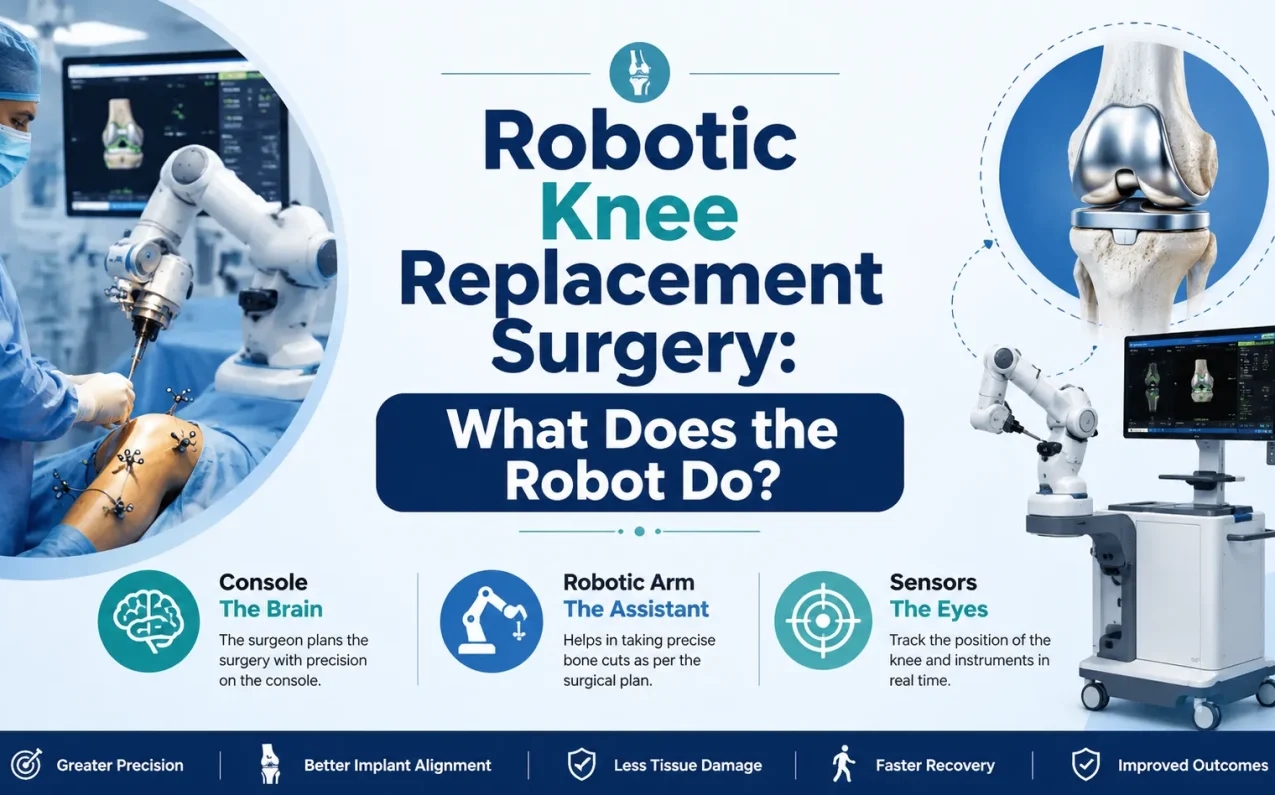
When patients hear the term “robotic knee replacement surgery,” many imagine a robot independently performing the entire operation. This common misconception often leads to questions such as: Does the robot replace the surgeon? What happens if the robot makes a mistake? How does robotic technology actually work during surgery?
The reality is very different. Robotic knee replacement is not a fully automated procedure. Instead, it is a highly advanced technology that assists the surgeon in performing the operation with greater precision and accuracy.
Understanding the role of robotic assistance can help patients make informed decisions about their treatment options and feel more confident about the surgical process. Since the success of robotic-assisted knee replacement depends significantly on surgical expertise and proper treatment planning, choosing experienced specialists is equally important. Patients exploring advanced joint replacement options can also learn about the best doctors for knee replacement surgery in Delhi to better understand their treatment choices and find the right orthopedic care.
What Is Robotic Knee Replacement Surgery?
Table of Contents
ToggleRobotic knee replacement surgery is a technology-assisted procedure designed to help surgeons perform bone preparation and implant positioning with a high level of accuracy.
The robot does not replace the surgeon. Rather, it acts as a sophisticated tool that helps execute the surgeon’s treatment plan more precisely. Every critical decision, including surgical planning and implant placement, remains under the surgeon’s control.
This is why the procedure is more accurately described as robotic-assisted knee replacement surgery. It is one of several modern approaches used to treat severe knee arthritis and joint damage. Patients who want to understand how robotic-assisted procedures compare with traditional and other surgical techniques can explore the different types of knee replacement surgery explained to gain a better understanding of their available treatment options.
How Does a Robotic Knee Replacement System Work?
Contrary to popular belief, surgical robots do not resemble human-like machines with arms, legs, and a head. Instead, a robotic joint replacement system typically consists of three main components:
1. The Console (The Robot's Brain)
The console serves as the central control unit of the robotic system. It is where the surgeon plans the procedure and monitors the surgical process.
The console receives information from sensors and coordinates communication between different parts of the system, ensuring accurate execution of the surgical plan.
2. The Robotic Arm
The robotic arm is the component involved in preparing the bone during surgery. Based on the surgeon’s plan, it assists in making precise bone cuts required for implant placement.
Depending on the system being used, the robotic arm may either perform the cutting action under controlled guidance or assist the surgeon in performing the cuts.
3. Sensors (The Robot's Eyes)
Sensors are attached both to the patient’s bones and to the robotic arm during surgery.
These sensors continuously track the position of the patient’s leg and the robotic instruments. The information is transmitted to the console, allowing the system to understand exactly where everything is located throughout the procedure.
This real-time communication helps maintain precision and coordination during surgery.
Step-by-Step: What Happens During Robotic Knee Replacement Surgery?
Understanding the surgical workflow can help patients appreciate how robotic technology supports the procedure.
Patient Positioning
Once the patient is on the operating table, the surgical team positions the leg appropriately for the procedure.
Sensor Placement
Special sensors are attached to the thigh bone (femur) and the shin bone (tibia). These sensors allow the robotic system to continuously monitor the exact position of the patient’s leg.
Mapping the Knee
A specialized instrument is used by the surgeon to identify multiple anatomical points around the knee and leg.
By marking these reference points, the surgeon provides the robotic system with detailed information about the patient’s unique anatomy and joint position.
Surgical Planning
Using information collected from the sensors and anatomical mapping, the surgeon develops a precise surgical plan on the console.
This planning stage determines the exact bone cuts and implant positioning needed to achieve proper alignment and balance within the knee joint.
Bone Preparation
Once the surgical plan is finalized, the robotic arm assists in carrying out the planned bone cuts.
Some robotic systems perform the cutting process through robotic guidance, while others provide assistance to the surgeon, who directly controls the cutting instrument.
Regardless of the system used, the surgeon remains in control of the procedure.
Implant Placement and Completion
After bone preparation is complete, the remaining steps are performed by the surgeon. These include:
- Implant positioning
- Fixation of the implant
- Application of surgical materials where required
- Closure of the incision
- Final assessment of knee movement and stability
The surgeon is responsible for the overall success of the operation from beginning to end.
Does the Robot Perform the Entire Surgery?
No.
One of the most important facts patients should understand is that robotic technology does not independently perform knee replacement surgery.
The surgeon plans the operation, guides the procedure, places the implant, and completes all critical surgical steps.
The robot’s role is to assist with the accurate execution of the surgeon’s plan, particularly during bone preparation.
In simple terms, robotic technology supports the surgeon—it does not replace the surgeon.
Why Is Precision Important in Knee Replacement?
Successful knee replacement depends heavily on accurate implant positioning and proper alignment of the joint.
Traditional surgical techniques may allow for some degree of variation in bone cuts and implant placement. Robotic assistance helps reduce this variation by enabling highly precise execution of the planned cuts.
Greater accuracy can contribute to:
- Better implant alignment
- Improved joint function
- Enhanced stability
- More natural movement
- Longer implant lifespan
Precision is one of the key reasons robotic-assisted knee replacement has gained attention in modern orthopedic surgery.
Benefits of Robotic-Assisted Knee Replacement
Because robotic technology helps surgeons perform highly accurate bone preparation, several potential advantages may be observed.
Smaller Surgical Exposure
The precision of robotic guidance may allow surgeons to work within a more focused surgical area, potentially reducing the size of the incision required.
Reduced Soft Tissue Disturbance
More controlled bone preparation may help minimize unnecessary impact on surrounding muscles and soft tissues.
Less Postoperative Pain
With reduced tissue disruption, some patients may experience lower levels of discomfort during recovery.
Reduced Blood Loss
More precise surgical execution may contribute to less blood loss during the procedure.
Faster Recovery
Many patients benefit from improved early mobility and a smoother rehabilitation process due to reduced tissue trauma and accurate implant positioning.
Improved Implant Longevity
Accurate alignment and positioning may help the artificial joint function more efficiently over time, potentially extending the lifespan of the implant.
Is Robotic Knee Replacement Right for Everyone?
The suitability of robotic-assisted knee replacement depends on several factors, including:
- Severity of knee arthritis
- Degree of joint damage
- Bone quality
- Overall health condition
- Individual treatment goals
A detailed evaluation by an experienced orthopedic specialist is essential to determine whether robotic-assisted surgery is the most appropriate option.
How ConsultGrab Helps Patients Explore Knee Replacement Options
Choosing the right surgeon, hospital, and treatment approach can be overwhelming, especially when advanced technologies such as robotic-assisted surgery are involved.
ConsultGrab helps patients navigate these decisions by providing:
- Free treatment guidance
- Assistance in finding experienced orthopedic specialists
- Support with appointment scheduling
- Transparent treatment and cost comparisons
- Access to a trusted hospital network in Delhi
- End-to-end coordination throughout the treatment journey
Our goal is to ensure that patients receive clear information, trusted medical guidance, and support at every stage of their knee replacement journey.
Conclusion
Robotic knee replacement surgery is not about replacing the surgeon with a machine. Instead, it combines surgical expertise with advanced technology to achieve greater precision during key parts of the procedure.
The robotic system consists of a console, a robotic arm, and sensors that work together to assist the surgeon in executing a carefully planned operation. By enabling accurate bone cuts and precise implant positioning, robotic-assisted surgery may contribute to improved alignment, better function, and a smoother recovery experience. Patients interested in optimizing their rehabilitation and returning to daily activities sooner can learn more about faster recovery after knee replacement surgery: tips and advances to understand the factors that support successful healing.
For patients considering knee replacement, understanding how robotic technology works can help remove misconceptions and support more informed treatment decisions..
Frequently Asked Questions (FAQs)
Robotic knee replacement surgery is an advanced form of knee replacement in which a robotic system assists the orthopedic surgeon during the procedure. The robot helps with surgical planning and precise bone preparation, while the surgeon remains in full control of implant placement, alignment, and all critical surgical decisions.
No. Robotic knee replacement is a robotic-assisted procedure, not an autonomous surgery. The orthopedic surgeon performs the operation and makes all treatment decisions. The robotic system supports the surgeon by helping execute the planned bone cuts with a high level of accuracy and precision.
A robotic knee replacement system uses sensors, real-time tracking, and a planning console to monitor the position of the patient's leg and surgical instruments. This technology helps the surgeon perform precise bone cuts and achieve accurate implant positioning, which can improve joint alignment and overall surgical outcomes.
Robotic-assisted knee replacement may offer several advantages, including more precise implant placement, smaller surgical exposure, reduced soft tissue disruption, less blood loss, and potentially faster recovery. Improved accuracy can also contribute to better joint function and may help increase the longevity of the knee implant.
A robotic knee replacement system typically consists of three main components: a console that serves as the planning and control center, a robotic arm that assists with bone preparation, and sensors that track the position of the patient's bones and surgical instruments. These components work together to support precise surgical execution.