

Understanding AVN Treatment at Every Stage
Table of Contents
ToggleIntroduction
Avascular Necrosis (AVN) of the hip is a progressive condition that can significantly affect mobility, independence, and quality of life. Many patients diagnosed with AVN eventually ask the same question:
Does hip replacement cure avascular necrosis?
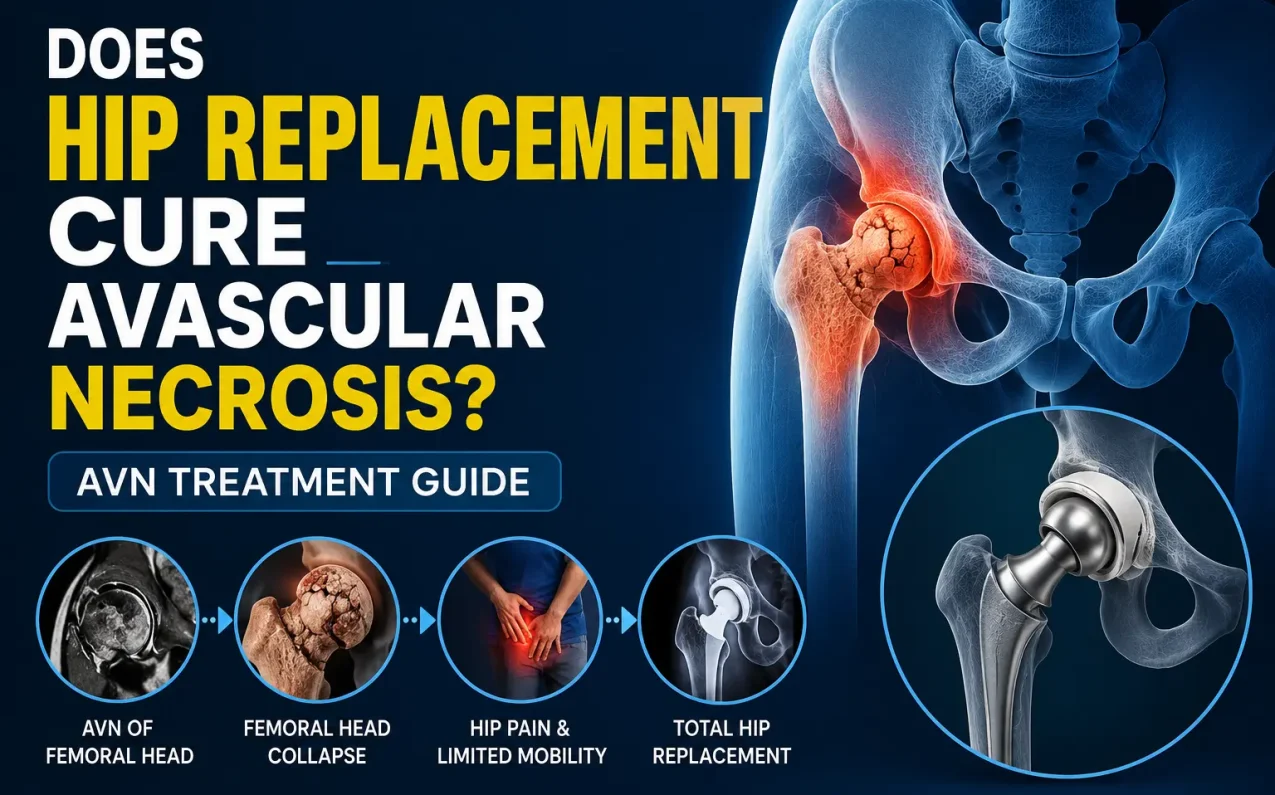
The answer depends on the stage of the disease. In the early stages, doctors often focus on preserving the natural hip joint through lifestyle changes, medications, physiotherapy, and joint-preserving procedures. However, when AVN progresses and causes collapse of the femoral head and arthritis of the hip joint, total hip replacement often becomes the most effective treatment option for relieving pain and restoring function.
This guide explains what AVN is, its causes, available treatment options, and when hip replacement may be recommended.
What Is Avascular Necrosis (AVN) of the Hip?
Avascular Necrosis, commonly known as AVN, is the death of bone tissue caused by a reduced or interrupted blood supply.
In the hip joint, AVN most commonly affects the femoral head, which is the ball-shaped upper part of the thigh bone. The hip is a ball-and-socket joint:
- The femoral head forms the ball.
- The acetabulum forms the socket.
When the blood supply to the femoral head is compromised, the bone gradually weakens. Over time, it may collapse, causing arthritis of the hip joint and resulting in pain, stiffness, and reduced mobility.
Without appropriate treatment, AVN often progresses and can severely impact daily activities.
What Causes AVN of the Hip?
Several factors may contribute to the development of AVN.
Common causes include:
- Long-term steroid use
- Excessive alcohol consumption
- Previous hip injury or fracture
- Certain blood disorders
- Autoimmune disorders
- Metabolic conditions
In some cases, no specific cause can be identified. These cases are often referred to as idiopathic AVN.
Risk Factors You Can and Cannot Control
Some risk factors are beyond a person’s control, while others can be modified.
Non-Modifiable Risk Factors
These include:
- Certain blood disorders
- Autoimmune diseases
- Some underlying medical conditions
Modifiable Risk Factors
These include:
- Alcohol consumption
- Smoking
- Long-term steroid use (when medically avoidable)
Reducing these risk factors may help support joint health and potentially slow disease progression.
Understanding the Stages of AVN
The stage of AVN plays a major role in determining the most appropriate treatment.
Stage 1
- Changes are visible only on MRI.
- The shape of the femoral head remains normal.
- No collapse is present.
Stage 2
- Changes become visible on X-rays.
- Early structural damage begins.
Stage 3
- The femoral head starts collapsing.
- Pain becomes more significant.
- Stiffness increases.
- Walking and daily activities become difficult.
Stage 4
- Advanced joint damage develops.
- Hip arthritis is present.
- Mobility becomes severely restricted.
Treatment Options for Early-Stage AVN
When AVN is diagnosed in Stage 1 or Stage 2, treatment focuses on preserving the natural hip joint.
Lifestyle Modifications
Patients are often advised to:
- Stop smoking
- Avoid excessive alcohol consumption
- Review steroid use with their doctor
- Maintain a healthy body weight
These changes may help reduce further stress on the affected hip.
Physiotherapy and Exercise
Structured physiotherapy programmes and hip-strengthening exercises can help maintain movement and function.
Medications
Certain medications may be prescribed to support blood circulation and symptom management.
Core Decompression Surgery
Core decompression is one of the most commonly used joint-preserving procedures in early-stage AVN.
During this procedure:
- A small channel is created through the neck of the femur.
- The aim is to improve blood flow to the affected area.
- Pressure inside the bone may be reduced.
- The goal is to slow disease progression and preserve the natural hip joint.
In some cases, surgeons may combine core decompression with:
- Bone grafting
- Bone marrow-based procedures
- Stem cell therapies
- Platelet-rich plasma (PRP) techniques
These approaches are intended to improve healing potential and support bone preservation.
What Happens When AVN Progresses?
Despite treatment efforts, AVN can continue to progress in some patients.
As the disease advances, patients may experience:
- Persistent hip pain
- Difficulty walking
- Reduced range of motion
- Difficulty climbing stairs
- Problems sitting comfortably
- Sleep disturbances caused by pain
Once the femoral head collapses and arthritis develops, conservative treatment options often become less effective.
Does Hip Replacement Cure Avascular Necrosis?
For patients with advanced AVN, particularly Stage 3 and Stage 4 disease, total hip replacement is often considered the most reliable treatment option. Understanding the surgical process, implant options, recovery expectations, and treatment expenses can help patients make informed decisions. Our comprehensive guide on Hip Replacement Surgery: Procedure, Types & Cost explains everything you need to know before considering surgery.
During hip replacement surgery:
- The damaged femoral head is removed and replaced.
- The damaged socket portion of the joint is replaced.
- Artificial components create a new, smooth-moving joint.
While hip replacement does not reverse the underlying damage that has already occurred, it effectively replaces the damaged joint surfaces responsible for pain and disability.
As a result, most patients experience:
- Significant pain relief
- Improved mobility
- Better joint movement
- Enhanced quality of life
- Improved ability to perform daily activities
For many patients with advanced AVN, hip replacement provides long-term functional improvement and restores independence.
What Does Clinical Research Show?
Research evaluating patients with advanced AVN has demonstrated encouraging outcomes following total hip replacement.
In a study involving patients with Stage III and Stage IV AVN of the femoral head, individuals underwent total hip replacement after conservative treatment options failed to provide adequate relief.
The findings showed:
- Significant improvement in hip function
- Marked reduction in pain
- Better range of motion
- Improved ability to perform everyday activities
The study concluded that total hip replacement remains one of the most predictable and effective treatment options for patients with advanced AVN and femoral head collapse.
These findings support the widely accepted approach of preserving the hip joint whenever possible in early disease while considering hip replacement once advanced joint damage has developed.
Hip Replacement in Younger and Older Patients
Modern hip replacement techniques have improved outcomes across different age groups.
Younger Patients
For younger individuals, surgeons often consider uncemented hip replacement components because they may provide durable long-term fixation and facilitate future revision procedures if needed.
Older Patients
In older adults, cemented implants may be considered depending on bone quality, overall health, and surgeon preference.
Treatment decisions are always individualized based on the patient’s condition and functional needs.
Recovery After Hip Replacement
Recovery varies from patient to patient, but many individuals experience gradual improvement in mobility and comfort after surgery. Understanding the complete recovery timeline and what to expect after surgery can help patients prepare better for rehabilitation. Our detailed guide on What Is Hip Replacement Surgery? Procedure, Recovery & Risks Guide explains the surgical process, recovery stages, potential risks, and long-term outcomes in greater detail.
Rehabilitation typically focuses on:
- Walking recovery
- Improving hip movement
- Strengthening surrounding muscles
- Returning to routine activities safely
Following medical advice and rehabilitation protocols is essential for achieving the best possible outcome.
When Should You See a Specialist?
You should consider seeking medical evaluation if you experience:
- Persistent hip pain
- Stiffness in the hip joint
- Difficulty walking
- Reduced range of motion
- Increasing discomfort during daily activities
Early diagnosis can provide access to joint-preserving treatments before significant damage occurs.
How ConsultGrab Can Help
Finding the right specialist and understanding treatment options can be overwhelming when dealing with AVN.
At ConsultGrab, we help patients connect with experienced orthopaedic specialists and trusted hospitals for comprehensive evaluation and treatment guidance.
Our support includes:
- Free treatment guidance from our care team
- Assistance in finding experienced orthopaedic specialists
- Appointment booking support
- Transparent treatment and cost comparisons
- Access to a verified hospital network
Whether you are exploring conservative treatment options for early-stage AVN or considering hip replacement surgery for advanced disease, our team can help you navigate the treatment journey with confidence.
Conclusion
Avascular Necrosis of the hip is a progressive condition that occurs when the blood supply to the femoral head becomes compromised. In the early stages, treatments such as lifestyle modification, physiotherapy, medications, and core decompression may help preserve the natural hip joint.
However, once the femoral head collapses and arthritis develops, total hip replacement often becomes the most effective solution for pain relief and functional recovery.
The key to achieving the best outcome is early diagnosis, appropriate treatment, and expert guidance. By understanding the stage of the disease and seeking timely medical advice, patients can make informed decisions about their hip health and long-term mobility.
Hip replacement does not reverse avascular necrosis itself, but it effectively treats the damage caused by advanced AVN. When the femoral head collapses and hip arthritis develops, total hip replacement replaces the damaged joint surfaces, providing significant pain relief, improved mobility, and better quality of life for most patients.
Hip replacement is typically recommended for Stage 3 or Stage 4 avascular necrosis when the femoral head has collapsed or severe arthritis has developed. It is generally considered that after conservative treatments such as medications, physiotherapy, lifestyle modifications, or core decompression, no longer provide adequate pain relief or functional improvement.
Yes, early-stage avascular necrosis can often be managed without hip replacement. Treatment options may include medications, physiotherapy, weight management, lifestyle changes, and core decompression surgery. These approaches aim to preserve the natural hip joint and slow disease progression before significant bone collapse occurs.
Advanced avascular necrosis of the hip commonly causes persistent hip pain, stiffness, reduced range of motion, difficulty walking, and discomfort during daily activities. As the femoral head collapses and arthritis develops, symptoms often worsen, making routine movements such as climbing stairs, sitting, or sleeping increasingly difficult.
Total hip replacement is considered one of the most effective treatments for advanced avascular necrosis of the femoral head. Most patients experience substantial pain relief, improved joint function, and enhanced mobility after surgery. Clinical studies have consistently shown good to excellent functional outcomes in patients undergoing hip replacement for advanced AVN.