

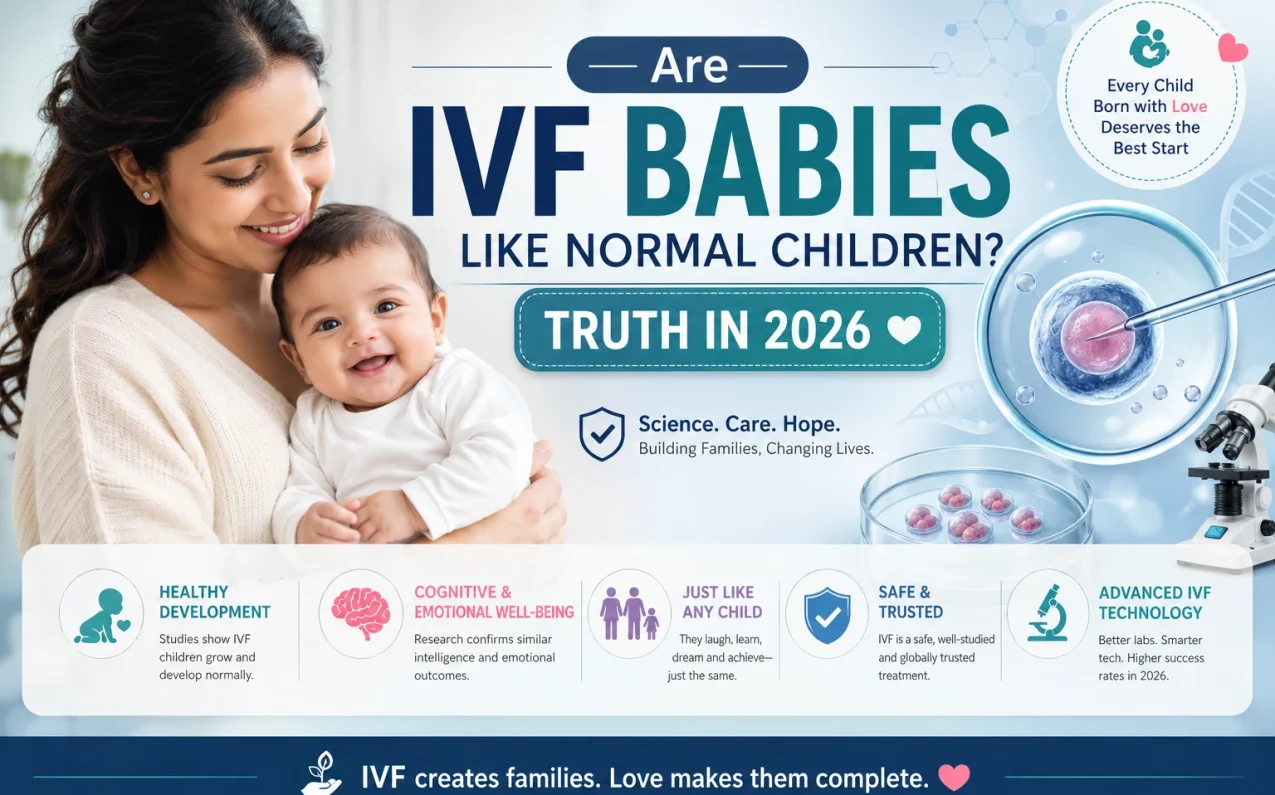
For many couples struggling with infertility, one question often creates fear, confusion, and hesitation: “Are IVF babies like normal children?”
The answer supported by decades of medical observation is simple — yes, IVF babies are as normal and healthy as naturally conceived children.
In recent years, especially throughout 2026, discussions around fertility treatments and assisted reproduction have become more open and medically informed. As awareness increases, fertility specialists continue to clarify that IVF is a scientifically established and medically safe procedure that has helped millions of families achieve parenthood worldwide.
At ConsultGrab, we understand how emotionally challenging infertility can be. Our role is to guide patients toward trusted fertility specialists, explain treatment options clearly, and provide support throughout the parenthood journey.
Understanding IVF in Simple Terms
Table of Contents
ToggleIn Vitro Fertilization (IVF) is a fertility treatment where eggs and sperm are combined in a controlled laboratory environment to create embryos. These embryos are then transferred into the uterus for pregnancy.
Although fertilization begins outside the body, the pregnancy develops naturally inside the mother’s womb afterward — just like any other pregnancy.
This is why children born through IVF are biologically and developmentally similar to naturally conceived children.
Where Did the Myth About IVF Babies Come From?
Much of the misunderstanding around IVF began during the early years of fertility treatment when IVF technology was still new and unfamiliar to many people.
The world’s first IVF baby was born in 1978, and at that time, assisted reproductive technology was considered revolutionary. Because the procedure was new, several myths and concerns began circulating regarding the health and development of IVF-conceived children.
However, fertility medicine has evolved significantly over the last four decades.
Today’s IVF procedures involve:
- Advanced laboratory technology
- Improved embryo monitoring
- Better pregnancy management
- Enhanced hormonal support
- Safer fertility protocols
Modern reproductive medicine has made IVF far more advanced, reliable, and medically supervised than ever before.
Are IVF Babies Healthy?
Long-term studies conducted across different countries have consistently shown that IVF children generally grow and develop similarly to naturally conceived children.
Medical observations over decades continue to show:
- Normal physical growth
- Healthy emotional development
- Similar learning abilities
- Comparable mental development
- Normal social behavior
Fertility experts and medical organizations worldwide continue to support the safety of IVF treatment for both mothers and babies.
The health of a child depends on several important factors such as:
- Genetics
- Maternal health
- Nutrition
- Prenatal care
- Environment
- Emotional support
The method of conception alone does not determine a child’s future health or abilities.
Why IVF Discussions Became Important Again in 2026 ?
In 2026, conversations around infertility and fertility treatment have become more common as more couples openly seek medical support for conception challenges.
At the same time, specialists continue working to remove outdated myths surrounding IVF pregnancies and IVF babies.
Medical experts now emphasize that IVF is not an “artificial” way of creating children. Instead, it is a medically assisted fertilization process that helps couples conceive when natural pregnancy becomes difficult.
Millions of healthy IVF births worldwide have helped strengthen public confidence in fertility treatments.
IVF Myths vs Medical Facts
Myth: IVF babies are different from other children
Fact: IVF children generally experience normal physical, emotional, and mental development similar to naturally conceived children.
Myth: IVF is still experimental
Fact: IVF has been safely practiced for more than 40 years and has helped millions of families globally.
Myth: IVF pregnancies are unnatural
Fact: IVF only assists the fertilization process. After embryo transfer, pregnancy develops naturally inside the uterus.
Myth: IVF always leads to complications
Fact: Modern IVF procedures are medically supervised and considered safe for most patients under expert guidance.
Is IVF Pregnancy Different From Natural Pregnancy?
In many cases, IVF pregnancies are managed similarly to natural pregnancies.
One important difference is that IVF pregnancies may require additional hormonal support during the early stages, especially during the first trimester. This support is usually provided through medications or injections to help maintain implantation and early pregnancy development.
Apart from this, prenatal care and pregnancy monitoring are generally comparable to natural pregnancies.
Understanding Certain Pregnancy Risks
Some studies have shown a slightly higher chance of:
- Low birth weight
- Premature delivery
- Multiple pregnancies
However, specialists explain that these risks are often linked to factors such as:
- Maternal age
- Existing health conditions
- Twin or multiple pregnancies
Modern fertility practices, including single embryo transfer techniques, have significantly reduced these risks in recent years.
IVF Includes Careful Medical Monitoring
One important advantage of IVF treatment is the level of medical supervision involved throughout the process.
IVF treatment may include:
- Hormonal evaluation
- Embryo assessment
- Regular monitoring
- Pregnancy tracking
- Specialist consultations
This careful medical approach often helps detect and manage concerns early, providing additional reassurance to parents.
Many couples also adopt healthier lifestyle habits during fertility treatment, including better nutrition, stress management, and improved prenatal care.
Safety of IVF for Mothers
IVF is widely considered a safe medical procedure when performed under proper specialist supervision. Choosing experienced fertility experts and reputed clinics can further improve treatment safety, monitoring, and patient care throughout the IVF journey. Many couples therefore prefer consulting the best IVF doctors in Delhi for safe and advanced fertility treatment before starting the procedure.
Some women may experience temporary side effects during treatment, including:
- Mild abdominal discomfort
- Bloating
- Nausea
- Hormonal fluctuations
These effects are generally short-term and manageable.
There are no commonly associated major long-term health risks for most women undergoing IVF treatment.
Factors That Affect IVF Success
IVF success depends on several biological and medical factors.
One important factor is embryo quality. Sometimes embryos may appear healthy during evaluation but still may not implant successfully due to internal biological conditions that cannot always be fully predicted.
Hormonal balance also plays an important role in determining the right time to begin IVF treatment. Certain ovarian cysts or hormone-related conditions may temporarily influence treatment planning.
This is why proper medical consultation and detailed fertility evaluation are extremely important before starting the IVF process.
Understanding the Financial Aspect of IVF
IVF treatment can involve significant financial planning. In many cases, treatment costs may range between approximately ₹2 lakh to ₹2.5 lakh depending on:
- Medications
- Fertility procedures
- Specialist consultations
- Follow-up care
- Additional treatments if required
Patients should always discuss:
- Expected treatment costs
- Medication expenses
- Additional procedure charges
- Follow-up expenses
Transparent communication helps families make informed decisions during treatment.
Since IVF expenses can vary from patient to patient, many couples prefer understanding the complete IVF cost in India along with treatment-related expenses and hidden charges before starting the process.
Emotional Support Is Important During Fertility Treatment
The fertility journey is not only medical — it is also emotional.
Couples often experience stress, uncertainty, anxiety, and emotional pressure during IVF treatment. Having proper guidance and a trusted support system can make the process smoother and more confident.
At ConsultGrab, we help patients connect with trusted fertility specialists and verified healthcare networks while offering:
- Expert treatment guidance
- Appointment assistance
- Transparent information
- Continuous care coordination
- Support throughout the fertility journey
Our goal is to ensure patients never feel alone during important healthcare decisions.
Final Thoughts
The conversation around IVF should now focus on medical understanding instead of outdated myths.
IVF babies are not different from other children in terms of growth, intelligence, emotions, or development. They are children born with the support of medical science and the love, care, and hope of their families.
With more than four decades of medical advancement and millions of healthy births worldwide, IVF continues to provide a safe and effective path to parenthood for couples facing infertility challenges.
If you are considering fertility treatment or exploring surrogacy and reproductive healthcare options, ConsultGrab can help connect you with experienced fertility specialists and trusted healthcare support for a smoother and more informed parenthood journey.
Frequently Asked Questions (FAQs)
Yes, IVF babies are generally as healthy as naturally conceived children. Long-term medical studies and fertility research show that children born through IVF usually experience normal physical growth, mental development, emotional well-being, and social behavior similar to children conceived naturally.
IVF is considered a safe and well-established fertility treatment in 2026. Modern IVF technology includes advanced embryo monitoring, hormonal evaluation, and medical supervision, helping millions of couples worldwide achieve healthy pregnancies and successful parenthood with reduced treatment risks.
IVF pregnancies are usually managed similarly to natural pregnancies, but they may require additional hormonal support during the first trimester. Fertility specialists also monitor embryo development and pregnancy progress closely to ensure better treatment outcomes and maternal health throughout the pregnancy journey.
The myth originated during the early years of IVF treatment when assisted reproductive technology was still new. However, more than four decades of medical advancements and research have confirmed that IVF babies develop normally and are not different from naturally conceived children.
IVF success depends on several factors including embryo quality, maternal age, hormonal balance, overall reproductive health, and medical evaluation. Proper fertility consultation, personalized treatment planning, and regular monitoring by experienced fertility specialists can improve the chances of a successful pregnancy.