

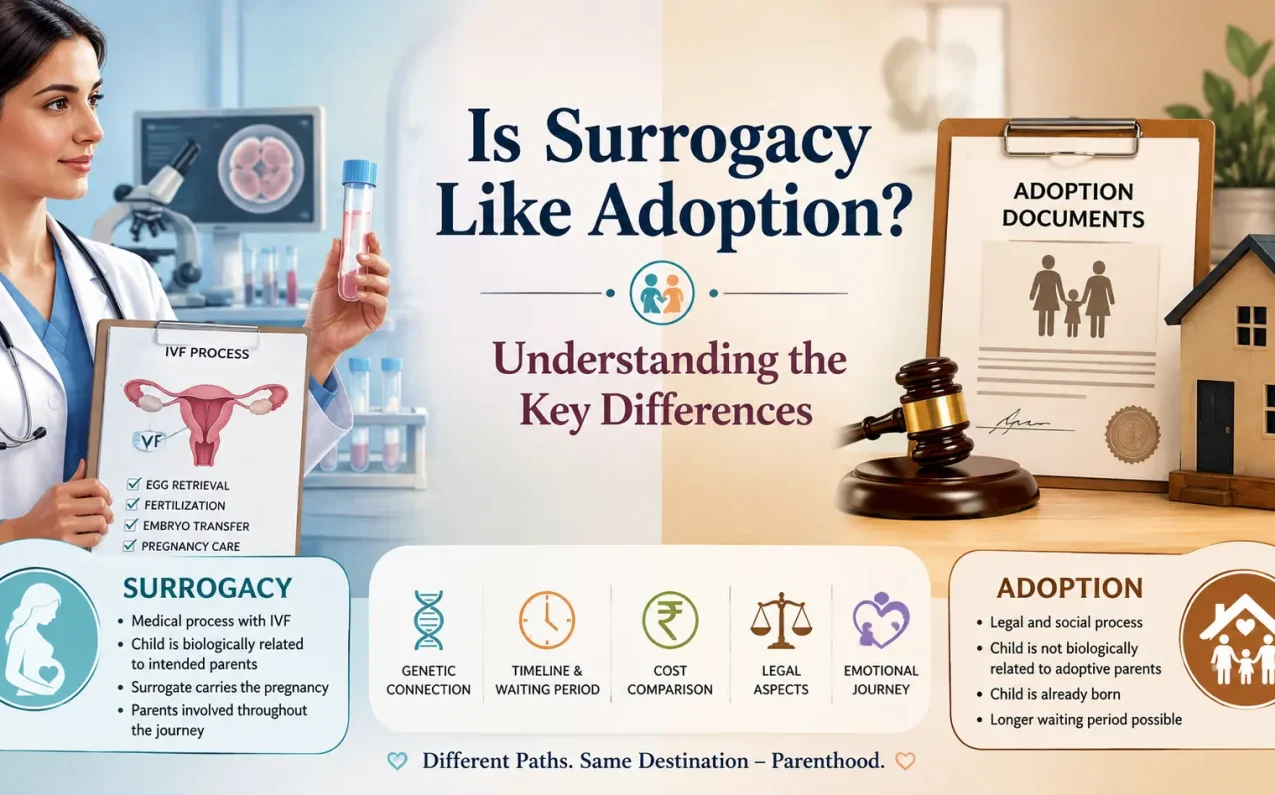
Many people wonder whether surrogacy and adoption are the same because both help individuals or couples become parents. While the final outcome is similar—a child becomes part of the family—the journey, medical process, legal pathway, and biological connection are very different.
This guide explains the difference between surrogacy and adoption in simple language so you can clearly understand how each option works.
Is Surrogacy Like Adoption?
Table of Contents
ToggleNo. Surrogacy is not the same as adoption.
Surrogacy is a medical and biological process in which a pregnancy is carried by a surrogate after an embryo is created through IVF. Adoption, on the other hand, is a legal and social process in which parents legally welcome a child who has already been born.
Although both provide a path to parenthood, they differ in genetics, pregnancy, medical involvement, legal procedures, costs, and timelines.

Calculate Cost Now
Genetic Connection: The Biggest Difference
The most important difference between surrogacy and adoption is the genetic relationship between parents and the child.
Surrogacy
In gestational surrogacy, an embryo is created using the intended parents’ egg and sperm through IVF. The embryo is then transferred to the surrogate, who carries the pregnancy.
As a result, the child has a biological connection with the intended parents.
Adoption
In adoption, the child is already born, and the biological parents are different from the adoptive parents.
This means there is no genetic or DNA relationship between the child and the adoptive family.
Surrogacy vs Adoption: Key Differences
1. Medical Process
Surrogacy
Surrogacy involves advanced fertility treatment. The process includes IVF, embryo creation, egg retrieval, embryo transfer, and continuous medical care throughout the pregnancy.
Related Guide
Planning for surrogacy also means understanding the complete financial commitment involved. Explore our Surrogacy Cost Breakdown in India: Complete Guide for Intended Parents (2026) to learn about IVF costs, legal expenses, insurance, and other major components of the surrogacy journey.
Adoption
Adoption does not involve any medical treatment. It is primarily an administrative and legal process involving government agencies and adoption procedures.
2. Pregnancy and Health Monitoring
Surrogacy
The pregnancy is monitored from the beginning. Doctors supervise the medical care, and the intended parents remain involved throughout the pregnancy journey.
Adoption
Since the child is already born, the adoptive parents do not have control over or complete knowledge of the pregnancy and prenatal health history.
3. Timeline and Child's Age
Surrogacy
The journey generally follows the pregnancy timeline. After embryo transfer, the baby is born approximately nine months later and joins the intended family as a newborn.
Adoption
The waiting period may be much longer and can sometimes extend for one to three years. Depending on the adoption process, the child may be a newborn or an older child.
4. Financial Considerations
Surrogacy
Surrogacy is usually a higher-cost option because it includes IVF treatment, legal procedures, insurance for the surrogate, pregnancy-related care, and other medical expenses.
Related Guide
Wondering whether surrogacy costs more than IVF alone? Explore our Surrogacy vs IVF: Which Is More Expensive? Cost Guide to understand how the expenses differ and what intended parents should expect before starting treatment.
Adoption
Adoption is generally more affordable because it mainly involves legal documentation, administrative procedures, and government-approved processing fees.
Calculate Cost Now
Emotional Journey
Both options involve different emotional experiences.
In surrogacy, intended parents often participate throughout the pregnancy by following medical appointments, ultrasound updates, and the baby’s development before birth.
In adoption, families usually experience a waiting period before being matched with a child. Many parents find emotional fulfillment in providing a loving home to a child who needs one.
Neither journey is better than the other—they simply offer different paths to building a family.
Start Your Parenthood Journey Today
Legal Perspective
The legal framework for surrogacy and adoption is also different.
Surrogacy is governed by specific eligibility requirements, and it is available only under certain legal conditions.
Related Guide
Want to understand the legal framework in detail? Read our What Are the Surrogacy Act in India? Complete Legal Guide to learn about eligibility, legal requirements, and the regulations governing surrogacy in India.
Adoption follows a separate legal process with its own eligibility rules and approval procedures. The waiting period may vary depending on the circumstances.
Understanding the applicable legal requirements is an important part of choosing either path.
How ConsultGrab Can Help
Choosing between surrogacy and adoption is a deeply personal decision, and every family’s situation is different.
At ConsultGrab, we help intended parents connect with experienced fertility specialists who can explain the surrogacy process, discuss available treatment options, and guide them through each stage with clear and transparent information. Our goal is to ensure patients receive trusted medical guidance and feel supported throughout their parenthood journey.
Conclusion
Surrogacy and adoption should not be considered the same.
Surrogacy is a medical and biological path to parenthood, where pregnancy is achieved through IVF and carried by a surrogate. Adoption is a legal and social path, where parents provide a permanent family to a child who has already been born.
Both journeys lead to the same destination—a loving family—but they follow completely different paths. Understanding these differences can help intended parents make a well-informed decision based on their personal, medical, and family circumstances.
Still Confused...... ??
Frequently Asked Questions (FAQs)
No. Surrogacy and adoption are different paths to parenthood. Surrogacy is a medical process in which a surrogate carries a pregnancy created through IVF, while adoption is a legal process in which parents provide a permanent home to a child who has already been born. Both achieve parenthood through different journeys.
The biggest difference is the biological connection. In gestational surrogacy, the child has a genetic relationship with the intended parents because the embryo is created through IVF. In adoption, the child is born to different biological parents, so there is no genetic connection with the adoptive family.
Yes, surrogacy is generally more expensive than adoption because it involves IVF treatment, medical care, legal procedures, insurance, and pregnancy-related expenses. Adoption is usually more affordable, as it primarily includes legal documentation, administrative procedures, and approved processing fees.
In surrogacy, the process generally follows the pregnancy timeline, and the baby is born about nine months after embryo transfer. Adoption may involve a longer waiting period, and families may be matched with either a newborn or an older child depending on the adoption process.
The choice depends on personal, medical, and family circumstances. Surrogacy may be suitable for those seeking a biological child through assisted reproduction, while adoption offers a legal path to providing a permanent family for a child who is already born. Understanding both options helps families make informed decisions.