

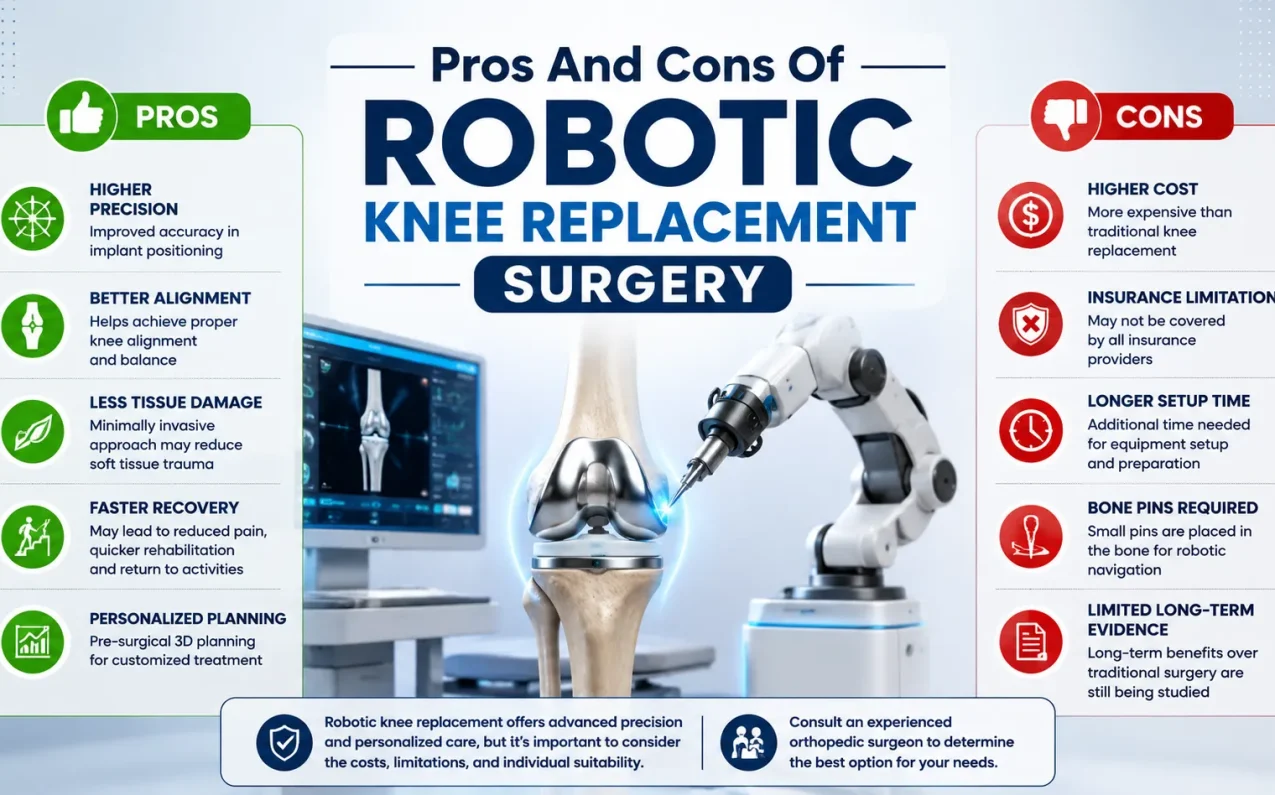
Robotic knee replacement surgery has become one of the most talked-about advancements in orthopedic care. Many patients considering knee replacement hear terms such as “robotic surgery,” “robot-assisted knee replacement,” and “AI-powered joint replacement” and naturally wonder whether these technologies offer better results than conventional surgery.
While robotic-assisted knee replacement can improve surgical precision and provide certain short-term benefits, it is important to understand that the technology also has limitations. The decision to choose robotic or conventional knee replacement should be based on individual patient needs, surgeon expertise, and realistic expectations. Consulting with the Best Doctors for Knee Replacement Surgery in Delhi can help patients understand whether robotic-assisted surgery is suitable for their condition and treatment goals.
In this article, we explore the advantages, disadvantages, current evidence, and future potential of robotic knee replacement surgery..
What Is Robotic Knee Replacement Surgery?
Table of Contents
ToggleRobotic knee replacement surgery is an advanced surgical technique in which a robotic system assists the orthopedic surgeon during specific steps of the procedure.
A common misconception is that the robot performs the surgery independently. In reality, the surgeon remains in complete control throughout the operation. The robotic system functions as a guidance tool that helps improve accuracy during bone preparation and implant placement. If you would like a detailed explanation of the technology, learn more about What the Robot Does During Robotic Knee Replacement Surgery and how it assists surgeons throughout the procedure.
Specialized sensors, cameras, and software help determine the position of the hip, knee, and ankle. Based on this information, the robotic system assists the surgeon in making precise bone cuts and positioning the implant according to the surgical plan.
The goal is not to replace the surgeon but to enhance precision and consistency during surgery.
Why Was Robotic Knee Replacement Developed?
The development of robotic-assisted joint replacement was driven by an important observation in orthopedic surgery.
Studies found that a percentage of patients remained dissatisfied even after technically successful knee replacement surgery. In many cases, factors such as implant positioning, alignment, and patient-specific anatomy were believed to contribute to dissatisfaction.
To improve surgical accuracy, navigation systems were introduced first. Robotic technology evolved from these navigation systems and was designed to help surgeons achieve more precise implant placement and alignment.
The ultimate aim was to improve patient satisfaction and optimize surgical outcomes.
How Does a Robot Help During Knee Replacement Surgery?
During robotic-assisted surgery, small pins are placed in the bones and connected to tracking sensors. These sensors allow the system to identify the exact position of the bones and soft tissues.
A camera continuously tracks the movement and position of the knee during surgery. The robotic software uses this information to assist the surgeon in planning and executing the procedure.
The robotic arm does not think independently or make decisions on its own. Instead, it follows the plan established by the surgeon and provides guidance to help achieve the desired implant positioning.
This additional layer of precision is one of the primary reasons robotic systems have gained popularity in knee replacement surgery.
Advantages of Robotic Knee Replacement Surgery
1. Smaller Surgical Exposure
Robotic technology can allow surgeons to work within a more controlled and precise surgical field. This may reduce the amount of tissue disruption during surgery and often results in smaller surgical exposure.
2. Reduced Blood Loss
Because robotic systems assist with precise bone preparation and implant placement, unnecessary tissue handling may be minimized. This can contribute to lower blood loss during surgery.
3. Less Soft Tissue and Muscle Damage
The increased precision offered by robotic assistance may reduce trauma to surrounding muscles and soft tissues. Preserving these structures can contribute to a smoother recovery process.
4. Faster Early Recovery
Many patients experience improved mobility and faster recovery during the first few months after robotic knee replacement. Reduced tissue disruption and improved surgical accuracy may contribute to these benefits.
5. Less Post-Operative Pain
Since there may be less soft tissue injury during surgery, patients often report lower pain levels during the early recovery phase.
6. More Accurate Implant Positioning
One of the most important advantages of robotic-assisted surgery is improved implant positioning.
The robotic system helps the surgeon execute highly precise bone cuts and implant placement according to the surgical plan. Better alignment and positioning are believed to contribute to improved knee function.
7. Real-Time Surgical Feedback
Robotic systems provide instant information regarding knee alignment, stability, and positioning throughout the procedure.
This allows the surgeon to make adjustments when necessary and helps achieve what orthopedic surgeons often describe as a “balanced knee”—a knee that is stable, straight, bends comfortably, and does not feel excessively loose or tight.
8. Potential for Longer Implant Survival
Because implant positioning can be more accurate, many experts believe robotic surgery may help improve implant longevity.
However, this remains a theoretical benefit that requires additional long-term research for confirmation.
Disadvantages of Robotic Knee Replacement Surgery
While robotic technology offers several advantages, it also comes with important limitations.
1. Additional Bone Pin Placement
To track the position of the bones during surgery, sensors must be attached to the femur (thigh bone) and tibia (leg bone).
This requires small pins to be inserted into the bones through drilled holes. Although complications are uncommon, these pin sites create a small risk of fracture or other related issues.
2. Higher Cost
Robotic-assisted knee replacement is generally more expensive than conventional knee replacement surgery.
The additional technology, equipment, and surgical planning involved contribute to higher treatment costs.
3. Insurance Coverage Limitations
Some insurance providers may not fully cover the additional costs associated with robotic surgery.
As a result, patients may have to pay some of these expenses themselves.
4. Longer Surgical Preparation
Depending on the robotic platform used, additional pre-operative planning may be required.
Some systems may involve extra imaging studies, such as CT scans or other advanced imaging, which can increase both cost and preparation time.
5. Longer Operating Room Setup
Robotic-assisted procedures often require additional setup and calibration during surgery. Although this does not necessarily affect patient outcomes, it can make the procedure more time-consuming.
6. Limited Long-Term Evidence
One of the most significant limitations of robotic knee replacement is the lack of long-term outcome data.
Current studies provide encouraging information regarding patient recovery, implant performance, and function over approximately three to five years. However, there is still insufficient evidence to confirm whether robotic surgery results in superior implant survival after 15, 20, or 25 years.
At present, improved implant longevity remains an expectation rather than a proven fact.
7. Implant Compatibility Restrictions
Many robotic systems are designed to work with specific implant manufacturers.
This means that hospitals using a particular robotic platform may be limited to certain implant options rather than having access to every implant available in the market.
8. The Robot Depends on Human Input
Robotic systems do not possess independent judgment.
The technology follows the information and instructions provided by the surgical team. If incorrect information is entered, the robot cannot independently identify or correct the mistake.
For this reason, robotic surgery remains heavily dependent on surgeon expertise and decision-making.
Is Robotic Knee Replacement Better Than Traditional Surgery?
This is one of the most common questions patients ask.
The answer is not straightforward.
Robotic technology is generally more precise in achieving the surgical goals selected by the surgeon. It can assist with implant positioning, alignment, and knee balancing.
However, highly experienced orthopedic surgeons performing conventional knee replacement can also achieve excellent results. Patient satisfaction rates following traditional knee replacement remain very high when surgery is performed by skilled specialists. It is also important to understand that robotic knee replacement is just one of several surgical options available for different patients and conditions. To learn more about these options, explore Types of Knee Replacement Surgery Explained, which provides an overview of the various knee replacement procedures and when they may be recommended.
Current evidence suggests that robotic surgery improves precision, but there is still no definitive proof that every patient will achieve better long-term outcomes simply because a robot was used..
When Is Robotic Knee Replacement Most Useful?
Robotic technology can be particularly valuable in complex situations.
Examples include:
- Significant deformity above or below the knee
- Previous fractures affecting leg alignment
- Growth-related bone abnormalities
- Existing metal hardware from prior surgeries
- Cases where conventional alignment techniques are difficult
In these situations, robotic guidance can help surgeons navigate complex anatomy and achieve more predictable alignment.
For many complex cases, robotic assistance may provide meaningful advantages over conventional techniques.
Can a Robot Replace an Experienced Surgeon?
No.
Robotic systems are advanced tools designed to assist surgeons, not replace them.
The success of knee replacement surgery still depends on factors such as:
- Accurate diagnosis
- Proper patient selection
- Surgical expertise
- Intraoperative decision-making
- Post-operative rehabilitation
Many experienced surgeons can achieve outstanding results using conventional techniques. Robotic technology should therefore be viewed as an additional tool that may enhance precision rather than a substitute for surgical skill.
The most important “computer” in the operating room remains the surgeon’s knowledge, judgment, and experience.
Is Robotic Knee Replacement a Game-Changing Technology?
At present, robotic knee replacement offers meaningful advantages but cannot yet be described as a complete game changer for every patient.
The technology clearly improves surgical precision and provides valuable real-time feedback. Early recovery outcomes are often encouraging, and robotic assistance may be especially beneficial in complex cases.
However, long-term superiority over conventional knee replacement has not yet been conclusively proven.
The future may be different. As robotic systems continue to evolve and become integrated with artificial intelligence and advanced data analytics, their capabilities may expand significantly. Future research may reveal additional benefits that are not yet fully understood today.
For now, robotic knee replacement should be viewed as an advanced surgical tool with specific advantages rather than a guaranteed superior option for every patient.
How ConsultGrab Helps Patients Choose the Right Knee Replacement Option
Choosing between robotic and conventional knee replacement surgery can be confusing, especially when patients receive conflicting information.
At ConsultGrab, we help patients make informed treatment decisions by connecting them with experienced orthopedic specialists and trusted hospitals.
Our care team assists with:
- Knee replacement treatment guidance
- Specialist consultations
- Hospital comparisons
- Appointment scheduling
- Treatment planning support
- Cost transparency
- Second opinion assistance
We believe every patient deserves clear information, expert guidance, and access to the most appropriate treatment option for their individual condition.
Conclusion
Robotic knee replacement surgery offers several potential advantages, including improved implant positioning, real-time surgical feedback, reduced tissue damage, and faster early recovery. However, it also has limitations such as higher costs, additional surgical preparation, implant compatibility restrictions, and a lack of long-term outcome data.
While robotic technology can improve precision and may be particularly useful in complex cases, it does not replace the expertise of an experienced orthopedic surgeon.
The best treatment choice depends on the patient’s condition, surgical requirements, and expert medical advice. Understanding both the advantages and disadvantages of robotic knee replacement surgery is the first step toward making a confident and informed healthcare decision.
Frequently Asked Questions (FAQs)
Robotic knee replacement surgery offers several potential benefits, including more accurate implant positioning, improved knee alignment, reduced soft tissue damage, less blood loss, and faster early recovery. The technology also provides real-time surgical feedback, helping surgeons achieve a balanced and stable knee replacement.
Robotic knee replacement surgery can improve surgical precision and implant placement, but it is not automatically better for every patient. Experienced orthopedic surgeons can achieve excellent outcomes with conventional knee replacement. The best option depends on the patient's condition, anatomy, and treatment requirements.
No, the robot does not perform the surgery independently. Robotic-assisted knee replacement is controlled entirely by the orthopedic surgeon. The robotic system acts as a guidance tool that helps with planning, alignment, and precise implant positioning while the surgeon remains responsible for all surgical decisions.
The main disadvantages of robotic knee replacement surgery include higher treatment costs, possible insurance coverage limitations, additional surgical preparation, and the need for sensor pin placement in the bones. Long-term evidence proving superior implant survival compared to traditional knee replacement is also still limited.
Robotic knee replacement may be particularly beneficial for patients with severe knee arthritis, complex deformities, previous fractures, abnormal leg alignment, or existing surgical hardware. In these situations, robotic technology can help surgeons achieve more accurate alignment and implant positioning during the procedure.