


Knee pain can make even simple daily activities difficult. Walking, climbing stairs, standing for long periods, or getting up from a chair may gradually become painful as the knee joint starts losing its natural cushioning. In many cases, this discomfort develops because of arthritis, cartilage damage, injury, or age-related wear and tear.
Today, several advanced surgical treatments are available to help patients regain mobility and reduce chronic knee pain. However, many people are often confused about which surgery is suitable for their condition, when surgery becomes necessary, and how much time the recovery process may involve. Patients who are planning surgery also frequently ask about how long knee replacement surgery takes and what to expect during the procedure.
This guide explains the different types of knee surgeries, how doctors decide the right treatment approach, and the modern implant options available for knee replacement procedures.
Understanding the Knee Joint
Table of Contents
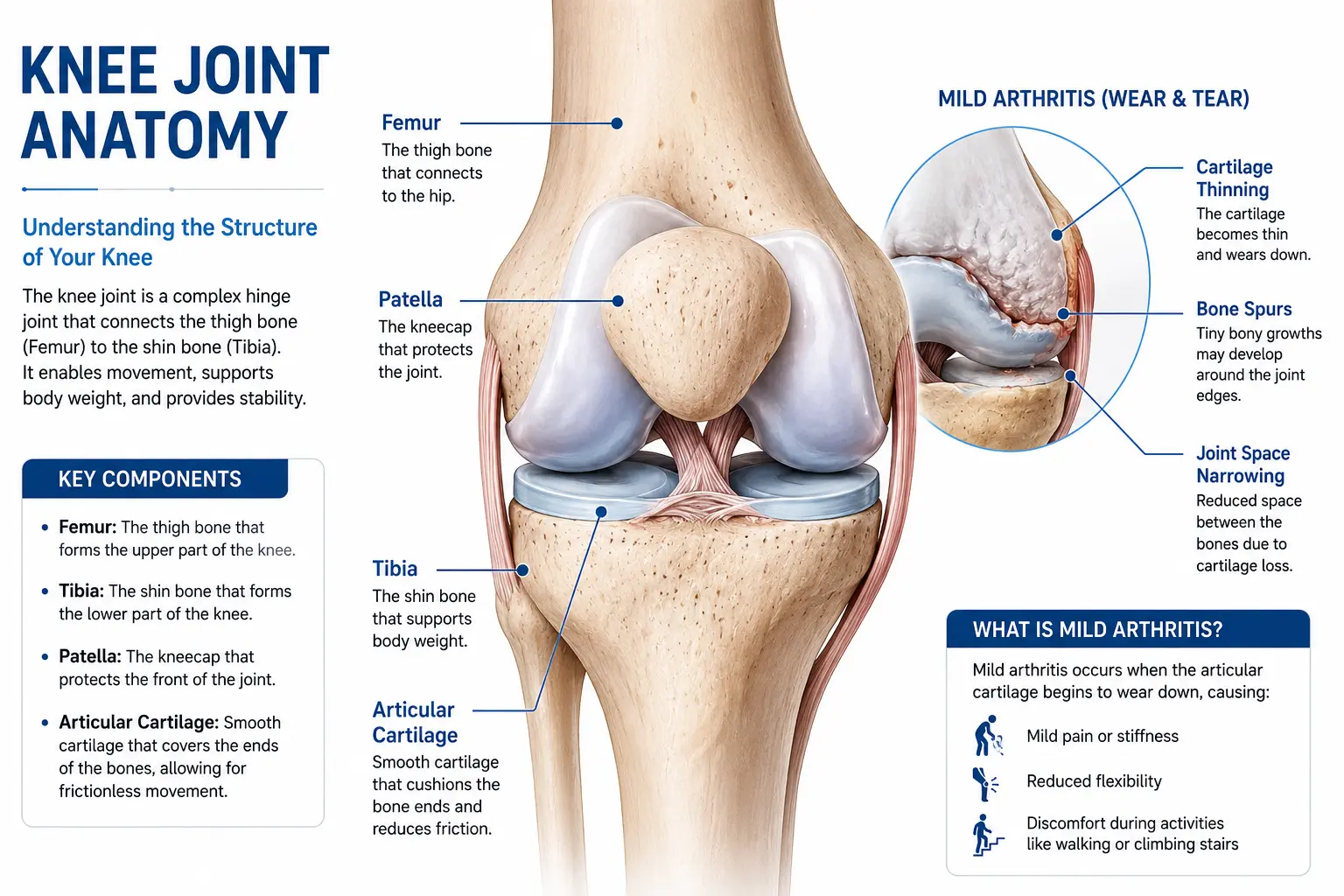
ToggleThe knee joint is formed by three important bones:
- Femur (thigh bone)
- Tibia (shin bone)
- Patella (kneecap)
These bones are covered with a smooth protective layer called articular cartilage. This cartilage allows the joint to move smoothly without friction.
As people age, or due to injury and arthritis, this cartilage may gradually wear away. Once the protective layer becomes damaged, the underlying bone surfaces begin rubbing against each other, leading to:
- Pain
- Swelling
- Stiffness
- Reduced mobility
- Difficulty walking
This condition is commonly associated with osteoarthritis of the knee.
Different Types of Knee Arthritis
The severity and location of arthritis help determine the most suitable surgical option.
1. Unicompartmental Arthritis
In this condition, arthritis affects only one section (compartment) of the knee, usually the inner side of the joint.
Patients may still have healthy cartilage in the remaining parts of the knee.
2. Tricompartmental Arthritis
This is a more advanced condition where all three compartments of the knee joint are affected.
Patients with severe pain, deformity, and limited movement are often diagnosed at this stage.
3. Patellofemoral Arthritis
In some rare situations, arthritis mainly affects the kneecap joint (patellofemoral joint).
Types of Knee Surgery
The choice of surgery depends on the severity of arthritis, patient age, activity level, and overall joint condition.
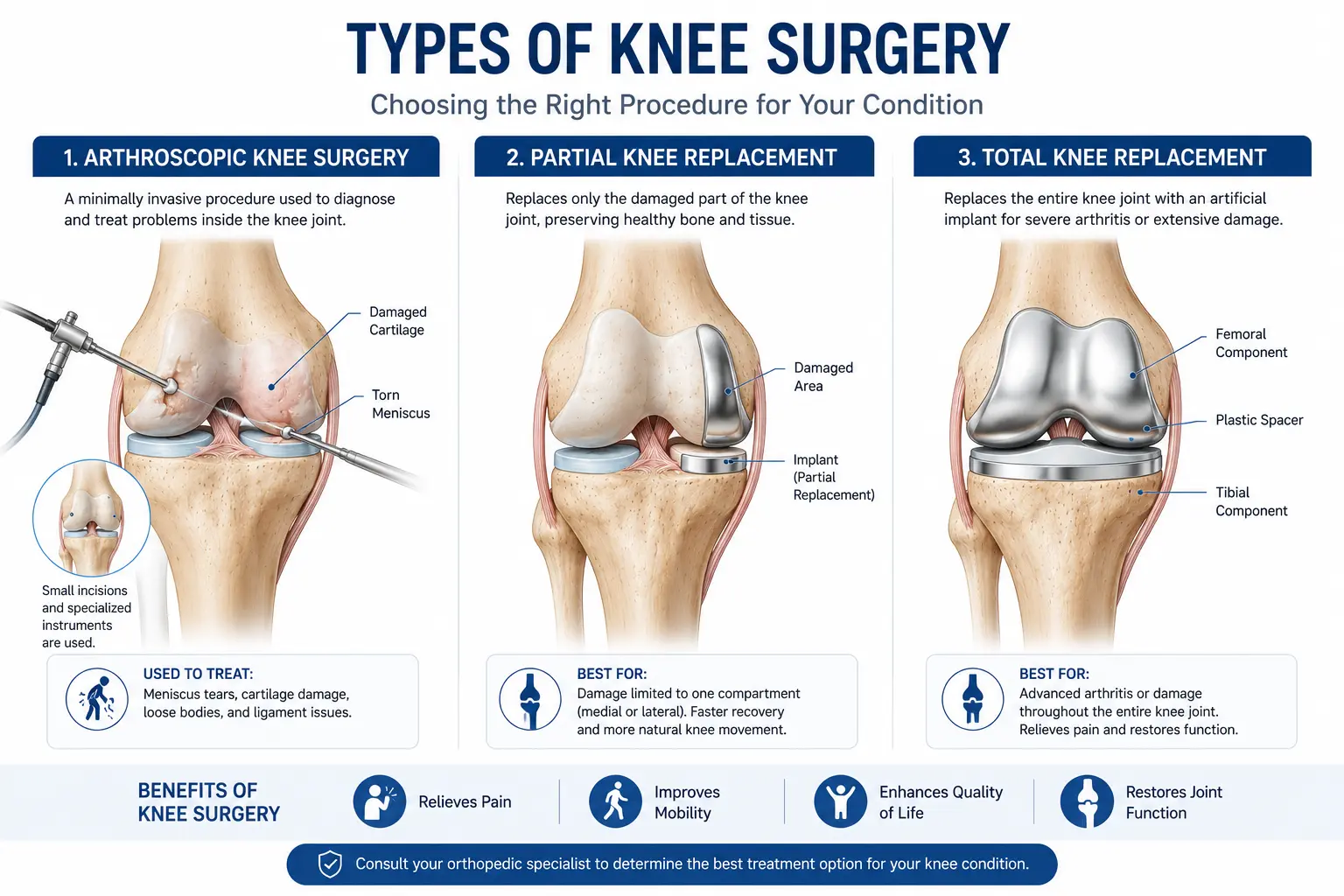
Arthroscopic Knee Surgery
Arthroscopy is a minimally invasive procedure commonly used for:
- Meniscus tears
- Minor cartilage damage
- Early-stage arthritis
- Joint cleaning procedures
Small instruments and a camera are inserted through tiny cuts around the knee. Recovery is generally faster compared to major replacement surgery.
This option is usually considered when arthritis is not very advanced.
Partial Knee Replacement (Unicompartmental Knee Replacement)
When arthritis is limited to only one compartment of the knee, doctors may recommend a partial knee replacement.
In this procedure:
- Only the damaged section is replaced
- Healthy bone and cartilage are preserved
- Recovery may be quicker than total knee replacement
- Knee movement often feels more natural
Partial knee replacement is generally suitable for selected patients with localized arthritis.
Total Knee Replacement
When arthritis becomes severe and affects the entire knee joint, a total knee replacement may be required.
In this procedure, the damaged surfaces of:
- Femur
- Tibia
- Patella
are resurfaced using artificial components.
The surgery essentially creates a new smooth joint surface using:
- Metal components
- A specialized plastic cushion between them
This plastic cushion allows smooth bending and movement while reducing friction between the metal surfaces.
Total knee replacement is often recommended for patients experiencing:
- Severe pain
- Significant stiffness
- Difficulty walking
- Reduced quality of life
- Failure of non-surgical treatments
How Knee Implants Work
A knee replacement implant typically consists of three major components:
Femoral Component
Attached to the thigh bone and commonly made from cobalt chrome metal.
Tibial Component
Placed on the shin bone and often made using titanium-based materials.
Polyethylene Insert
A durable plastic liner placed between the metal components to allow smooth movement.
Some modern inserts are manufactured using highly cross-linked polyethylene or Vitamin E-enriched polyethylene for improved durability.
Types of Knee Implant Designs
Modern knee replacement surgery offers several implant variations depending on patient needs, age, activity level, and budget.
All-Poly Design
This is one of the more basic implant options where the tibial component is made entirely of plastic instead of metal.
It may sometimes be considered in patients with financial limitations.
Metal-Backed Implants
In this design, the implant includes a metal-backed tibial tray. These implants are commonly selected for patients who may require better long-term support and durability.
High-Polish Advanced Implants
These implants are designed with improved surface finishing and are often considered for younger and more active individuals because of their enhanced longevity.
Advanced Premium Implant Options
Some newer-generation implants are developed to improve:
- Longevity
- Joint comfort
- Pain relief
- Natural movement
These implants are usually more expensive but are designed to provide improved patient satisfaction and long-term performance.
Fixed Bearing vs Mobile Bearing Knee Implants
Another important classification in knee replacement surgery is based on the movement of the plastic insert.
Fixed Bearing Implants
The plastic insert remains fixed to the tibial tray.
These are widely used and come in several variations.
Mobile Bearing Implants
In mobile bearing implants, the plastic insert can rotate slightly within the tray, allowing additional movement.
This design may help reduce stress on certain parts of the implant in selected patients.
Cemented Knee Replacement
The most commonly used and widely accepted technique for implant fixation is cemented knee replacement.
In this method, a specialized bone cement is used to securely attach the implant to the bone surfaces.
This approach is considered the standard technique because of its reliable long-term results.
Why Implant Design Matters
One of the important concerns in knee replacement surgery is implant wear over time.
Tiny wear particles may develop when the plastic component rubs against the metal tray. In some situations, these particles can contribute to implant loosening over many years.
To reduce this issue, manufacturers have developed:
- Compression-molded designs
- Modular implant systems
- Improved polyethylene materials
- Advanced implant surface technologies
These improvements aim to increase implant durability and long-term success.
When Should You Consider Knee Surgery?
Surgery may be considered if you experience:
- Persistent knee pain
- Difficulty walking
- Severe stiffness
- Reduced daily activity
- Failure of medicines and physiotherapy
- Advanced arthritis on imaging scans
The decision always depends on careful evaluation by an orthopedic specialist. Patients are also encouraged to understand the possible risks and complications of knee replacement surgery before making a final treatment decision, as awareness of recovery challenges and potential side effects helps set realistic expectations.
Choosing the Right Treatment Matters
Every patient’s condition is different. Some individuals may benefit from minimally invasive procedures, while others may require partial or total knee replacement surgery.
The right treatment depends on:
- Severity of arthritis
- Age
- Lifestyle
- Bone condition
- Overall health
- Functional limitations
Proper diagnosis and expert consultation are essential before making any surgical decision.
How ConsultGrab Supports Patients Seeking Knee Treatment
At ConsultGrab, we help patients connect with experienced orthopedic specialists and trusted hospitals for knee treatment guidance in Delhi.
Our support includes:
- Assistance in understanding treatment options
- Guidance for orthopedic consultations
- Help with appointment scheduling
- Transparent treatment and cost discussions
- Access to verified hospital networks
Whether a patient requires conservative management, arthroscopic surgery, partial knee replacement, or total knee replacement, the goal is to ensure informed decision-making and a smoother treatment journey.
Final Thoughts
Knee surgery has advanced significantly over the years, offering multiple treatment options depending on the stage and severity of joint damage.
From minimally invasive arthroscopy to advanced total knee replacement procedures, modern orthopedic care aims to reduce pain, improve mobility, and restore quality of life. Patients considering joint replacement should also understand what to expect during recovery and rehabilitation, including mobility improvement, physical therapy, and lifestyle adjustments after surgery. Learning about life after knee replacement surgery and long-term recovery care can help patients prepare both physically and mentally for successful outcomes.
Early consultation and proper evaluation can help patients understand which treatment approach is most suitable for their condition and long-term recovery goals.
Frequently Asked Questions (FAQs)
The main types of knee replacement surgery include partial knee replacement, total knee replacement, fixed bearing implants, and mobile bearing implants. Partial knee replacement is suitable when arthritis affects only one compartment, while total knee replacement is recommended when all compartments of the knee joint are damaged due to severe osteoarthritis.
Total knee replacement surgery is usually recommended for patients with severe knee arthritis, chronic pain, stiffness, and difficulty walking. It is considered when non-surgical treatments such as medicines, physiotherapy, and injections no longer provide relief and all compartments of the knee joint are affected.
Partial knee replacement involves replacing only the damaged section of the knee joint, preserving healthy bone and cartilage. Total knee replacement replaces the complete knee joint surfaces, including the femur, tibia, and patella, and is generally performed in advanced tricompartmental arthritis cases.
Modern knee replacement implants commonly use cobalt chrome for the femoral component, titanium for the tibial tray, and highly durable polyethylene plastic liners. Some advanced implants also use Vitamin E-enriched polyethylene to improve implant longevity and reduce wear over time.
Cemented knee replacement is a procedure where a special bone cement is used to securely fix the artificial knee implant to the bone surfaces. It is considered the standard and most widely used technique because it provides strong implant fixation and reliable long-term results for most patients.